
In the field of computer science, many men have received recognition for their technological contributions. Unfortunately, not many women have received acknowledgement for their developments in technology. Even if they aren’t well known, their contributions are immensely astonishing.
One female individual who made a significant contribution in the field of STEM is known as Grace Hopper. Hopper was born to a privileged family in New York on December 9, 1906. Her father, Walter Murray, was a wealthy insurance salesman, and her mother was a math-loving housewife with a genuine passion for education. As a young girl, Hopper was constantly driven with curiosity and loved to have hands-on experiences. Her passion for problem-solving started when she was just seven, wanting to disassemble an alarm clock for inspection.
At the age of 18, Hopper enrolled in Vassar College, the second-oldest college to grant degrees to women in the United States. She graduated with a doctorate in mathematics and pursued a teaching career at the college of Vassar. She had an immense enthusiasm for math and was highly committed to providing a well rounded education to her students. Her career as a mathematics professor, unfortunately, didn’t last long once World War II began. Many women were occupying positions as nurses and replacing men in the factory. Hopper wanted to serve her people despite her shortcomings. Serving in the military drastically changed her way of life, providing a more dynamic experience and greater liberty.
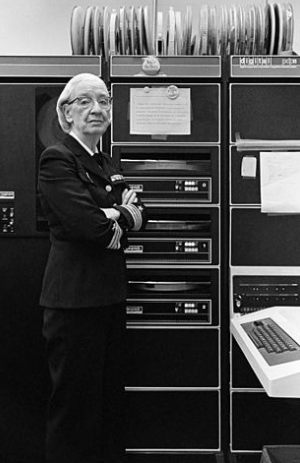
Not long after serving in the navy, Hopper was chosen to be sent to Harvard to work on the Automatic Sequence Controlled Calculator, also nicknamed as Mark I. Hopper was determined to be able to produce complex calculations in order to prove efficiency and in the process, ended up having an interest in programming. Hopper was proficient in learning how to program as it incorporated tons of numerical sequences, fostering problem-solving abilities. Consequently, she joined a full time job as a senior programmer at the Eckert Mauchly Computer Corporation where she introduced the famous computer program known as the compiler. The compiler was known to be a series of instructions for computers to follow without constant human intervention. Hopper’s first programming language was called the COBOL, also known as “Common Business Oriented Language”. This programming language was very efficient and to this day, it’s still widely practiced by many programmers. Hopper’s introduction of the compiler helped pave the way for newly incorporated programming languages, facilitating the technological development of modern day computers.
Additionally, Hopper was acknowledged for her inspection of a bug in an Aiken Relay Calculator, also known as “Mark II”. While in the process of a repair of the calculator, Hopper discovered a moth, describing it as a “bug” in the calculator. Her idea of a “bug” introduced a term referring to an actual malfunction in technology.
In 1966, Hopper came to announce that she was retiring as a member of the navy due to old age. Because of her commitment and her genuine passion for computer programming, she was asked to return to service, once again helping to serve the community. Hopper returned to work, creating efficient programming languages and simultaneously helping her supportive community.
Hopper pursued her dreams despite the huge gender gap in technology. She wanted to motivate future female programmers and prove that gender inequality could never interfere with discovering an enthusiasm for careers in the STEM field. She proved that the key to ultimate success is ambition and constant commitment. We should follow the footsteps of this motivational leader to stay committed to our dreams despite any interference.
Works Cited
“Grace Brewster Murray Hopper”, New York Historical Society
https://wams.nyhistory.org/confidence-and-crises/world-war-ii/grace-hopper/
“Admiral Grace Murray Hopper: When Women Were Computers”, Rob Wallace, National WWII Museum (picture)
https://www.nationalww2museum.org/war/articles/grace-hopper-woman-computer
“Grace Hopper Biography”, Christopher McFadden, 2021, InterestingEngineering (picture)
About the Author
Hello! My name is Nazifa Ibnat and I am a rising senior in high school. I am volunteering at this non profit organization as a blog writer to inspire young women to pursue a career in the STEM field.

 Her Stem Space
Leave a comment