In modern society, love is a form of showing affection for one another in many different ways. As we see today, love branches into media from books, films, language, and learning.

Despite this, many forms of studies have shown that love does not just come from this as it is in fact a science of our brain’s reaction upon experiencing signals of emotions, feelings, or gestures. Beyond this, it turns out that much of the reason why is because of natural causes in the brain that are actually normal in most to all people in some way in day to day life.
Having something as simple as a crush on someone can spark the brain to react as well as other causes such as transitions or deeper emotional connections with others.
A psychologist at the University of Chicago, Stephanie Cacioppo, who studied the neuroscience of romantic love for the past decade, explained in reasoning that much of the causes in the brain come from changes in the brain’s reward system. Two active regions of the brain— the ventral tegmental area (VTA) and caudate nucleus, are shown to be the main reason why this system is triggered. When the idea of falling in love makes a person feel good, supposedly the brain will react and these two regions will regulate a feeling or attachment in the brain called “neurotransmitter dopamine.” Known for their part in chemicals released by neurons in the brain, most of why they are active is actually because of the brain’s response to stimuli, or signals of the person. Having many forms of neurotransmitters in one’s body, a common one is dopamine, which acts as an organic amine that will send signals to the other nerve cells when in response to the feeling of doing something enjoyable that brings pleasure to the body
Dopamine can also help regulate other activities such as movement control, and role of memory, motivation, and processes from the human body. In other words, falling in love with something or someone will bring pleasure to the human body and process dopamine that’s in the body to react. Many neuroimaging research and that of others opinion suggest that the idea of love is a craving and feeling, that as long as it’s maintained, you will feel good even just thinking of them
Like the concept appears in many media today, the idea of addiction to this idea is the same as biologically feeling bonded to one thing.
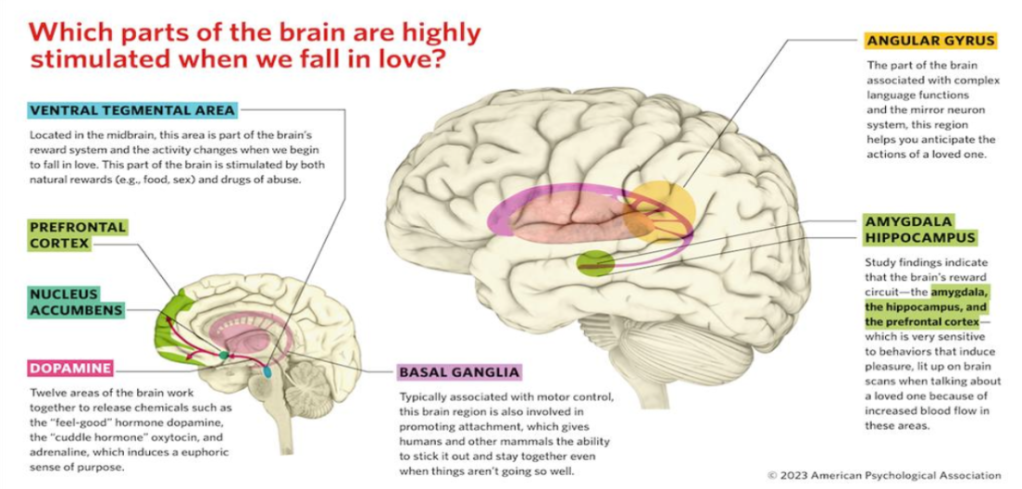
Even with many saying otherwise, Helen Fisher has been able to discuss that upon scanning the brains of various people in different stages of love, she’s noticed the pattern of various people.
Despite many gaps in our understanding still, studies still believe the early stages of attempting a romantic relationship is still dangerous because our brain might not be able to tell the difference of a slow romantic life compared to the nurture or desire for one’s romantic attention. However, because of others who suggest otherwise, the idea is still left untouched if our brain really is confirmed to not be able to react in such scenarios accordingly. As future researchers work in this study and continue to learn the brain’s pattern and processes at work, it can only be assumed that it will take years from the beginning to end to one’s relationship to for sure know the underlying neutral processes associated with the different types of love. The feeling and addiction we get is still left to be studied and much of what’s posted on online is many people who make attempts to associate love with other active parts of one’s brain. Often people can easily access their phones or google search to only find an article relating to questions of their attention and desire to a love life, and while much of what’s being sent is harmless, many people may feel confused upon seeing that people might be pushing other people’s stress and negative feelings.
While these feelings may be neutral, it may be a reason why we experience what we do in the confusion of the brain that struggles to tell the difference as we’re constantly being exposed to different forms of what’s good for us or not. Even if you have a partner, the lingering feeling and thinking of them can not just bring pleasure and enjoyment, but as well as buffer against pain, stress, intrusion, and more that often stops researchers from being able to have a complete understanding over the process of our brain’s way of thinking whenever it’s exposed to something new that it often feels emotionally attached to.
Works Cited
Tart-Zelvin, Xiaomeng Xu, Ariana. “What Goes on in Our Brains When We Are in Love?”
Scientific American, 19 July 2017, www.scientificamerican.com/article/what-goes-on-in-our-brains-when-we-are-in-love/.
Novotney, Amy. “What Happens in Your Brain When You’re in Love?”
Apa.org, 10 Feb. 2023,
www.apa.org/topics/marriage-relationships/brain-on-love.
“Your Brain on Love.” [Infographic] | MeetMindful.
MeetMindful | a Fuller Life Together, 18 July 2014, www.meetmindful.com/articles-love-your-brain-on-love-infographic/.
“Addicted to Love: A Chemical Explanation [TED Talk] | MeetMindful.”
MeetMindful | a Fuller Life Together, 20 May 2014, www.meetmindful.com/addicted-to-love-a-chemical-explanation/.
Watson, Stephanie. “Dopamine: The Pathway to Pleasure.” Harvard Health, Harvard Medical School, 20 July 2021, www.health.harvard.edu/mind-and-mood/dopamine-the-pathway-to-pleasure.
Health Direct. “Dopamine.” Healthdirect.gov.au, Healthdirect
Australia, 2 May 2019,
About the author

Hello! My name is Savannah Knox, a rising freshman student enrolled at Upland High School who strives in focusing my education in STEM subjects. I am interested in STEM because of the creative paths from STEM education that women throughout the years have been able to accomplish from a gender dominated space.

 Her Stem Space
Leave a comment