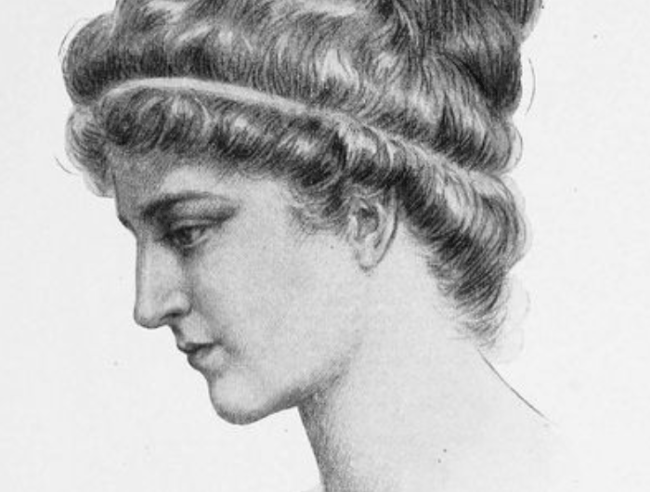
The era of Ancient Greece was the quintessential example of scientific and mathematical advancements. Philosophers and scientists such as Socrates, Plato, and Aristotle jump started a new, advanced era of STEM across the world. These men are often credited with leading the scientific advancements of ancient Greece, and making science and math what they are today. However, the women of the time are often forgotten by history. These women made large strides in the mathematical and scientific worlds. One such woman, the ‘mother of mathematics’, was Hypatia of Alexandria.
Born in 350 A.D. in Alexandria, Egypt, Hypatia was born to her father Theon of Alexandria. He was a well known scholar and mathematician in Greece, and sought to teach his daughter his many findings and thoughts.

In Hypatia’s century of Greece, women were discouraged, if not forbidden, from studying any form of math or science. Her father, going against the ideologies of the time, wanted Hypatia to be educated. He sought to teach his daughter himself. Throughout Hypatia’s childhood, her mind was filled with the wonders of Geometry, number theory, and Astronomy. Her father also taught her the Neoplatonism philosophy, which states that everything studied can be broken down into mathematical equations. Hypatia’s studies alongside her father sparked a passion for science and math; this passion would lead her to become the first recorded female astronomer and mathematician in all of history.
As Hypatia grew, she surpassed even her father in intelligence. With her large range of knowledge in Philosophy, mathematics, and astronomy, Hypatia quickly gained the attention of curious civilians. She began teaching at the Platonic school of Alexandria, where she taught her findings of simpler, clearer mathematical equations. For example, her discovery of one of the most current forms of long division.
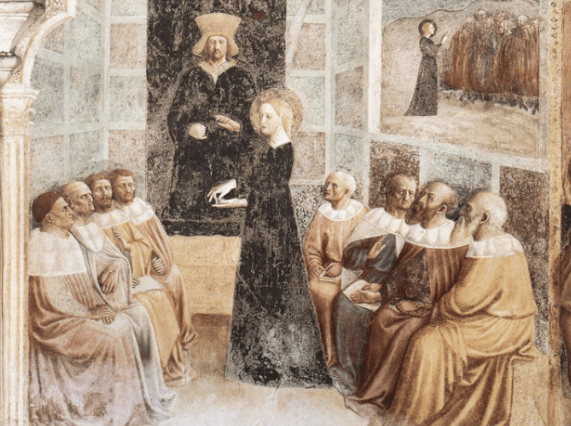
If you find long division easy, you can thank Hypatia! She even wrote her own math textbooks, detailing her research and theories. Furthermore, Hypatia was known for using and teaching the way of the Astrolabe, a device that was able to measure an angle between an horizon and a planet or star. Thanks to her teaching this knowledge in Astronomy, sailors used the device for centuries to determine their exact location on the ocean. Men from every faith traveled far and wide just to meet Hypatia, and discuss or listen to her findings. Despite her Pagan faith, Hypatia never discriminated against any of her listeners; she was an opening and understanding educational figure.
Hypatia’s life came to a tragic end at age 70, after giving philosophical advice to governor Orestes that went against Christian views. Hypatia was murdered in 415 A.D. The religious conflicts between Pagans and Christians were at an all time high, and Hypatia was brutally killed during one of her own lectures. Although her life ended in tragedy, Hypatia’s impact on the world of astronomy and math never died. Her copious teachings and theories have been passed down throughout the centuries. Furthermore, all women were given a gateway into having a voice in math and science, and making strides towards being just as respected as she was. Hypatia will forever be remembered as the pioneer of Women’s recognition in STEM.
About the Author:

Hello, my name is Elâ, and I am a rising Senior in high school (hey class of 2025)! I have been fascinated with biology and chemistry since I was very young, and I hope to share my love for science and its history through my articles!
Email: elaelisabethor@gmail.com

 Her Stem Space
Leave a comment