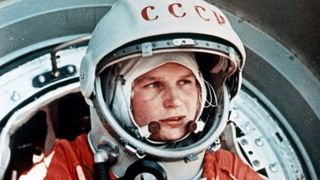
Born on March 6th, 1937, Tereshkova lived in Bolshoye Maslennikovo, a village in central Russia. She came from humble origins; her father was
a tractor driver, who would later be killed in World War ll, and her mother worked in a textile factory. Tereshkova followed in her mother’s footsteps, joining the textile industry due to the lack of formal education accessible to her. However, from a young age, she possessed a deep appreciation for flying, initially taking form in skydiving and parachuting. She joined a local aviation club, the Yaroslavl Air Sports Club. The Soviet Space program eventually took notice of her passion and experience, selecting her, from more than 400 applicants, for a rigorous 18-month training program. Here, she developed her skills and knowledge of space, gravity, emergency procedures, and isolation. Soon after, at just 24 years old, she was accepted into the Soviet Air Force; the youngest woman, and first civilian, in its history.
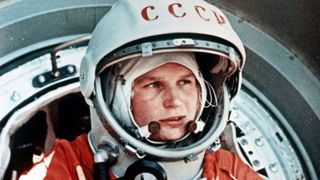
On June 16, 1963, Tereshkova launched on spacecraft Vostok 6, completing 48 orbits of Earth in 71 hours. To this day, she remains the only woman to have flown solo, at just 26 years old, the youngest! Her research and results were extraordinary; maintaining flight logs, and conducting tests to record her body’s reaction to the unknown environment. She took numerous photographs of the Earth and horizon, which later played a key part in identifying aerosol layers within the atmosphere. In a single flight, Tereshkova’s flight time was greater than that of all the US Mercury astronauts combined.
Her name and face were televised for the nation to honor, and, shortly after her return to Earth, Tereshkova was bestowed the ‘Order of Lenin’ and ‘Hero of the Soviet Union’ awards.
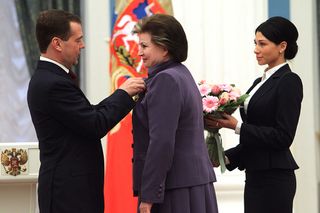
Her fame spread to the political world, and she took influential positions in government, even earning recognition internationally with the United Nations Gold Medal of Peace, the Simba International Women’s Movement Award, and the Joliot-Curie Gold Medal. Valentina Tereshkova is one of the key faces of early space exploration, and an inspiration to many women who wish to achieve similarly extraordinary feats.
Works Cited
-“First Woman in Space: Valentina.” ESA, The European Space Agency, 16 June 2013, www.esa.int/About_Us/ESA_history/50_years_of_humans_in_space/First_woman_in_space_Valentina.
-Lea, Robert. “Valentina Tereshkova: First Woman in Space.” Space.Com, Space, 22 Jan. 2018, www.space.com/21571-valentina-tereshkova.html.
-“Valentina Tereshkova.” Encyclopædia Britannica, Encyclopædia Britannica, inc., 22 May 2024, www.britannica.com/biography/Valentina-Tereshkova.
-“Who Was the First Woman in Space?” Royal Museums Greenwich, www.rmg.co.uk/stories/topics/who-was-first-woman-space#:~:text=The%20first%20woman%20to%20travel,human%2Dcrewed%20flight%20in%20space. Accessed 12 June 2024.
-Images 1 and 2 courtesy of https://www.space.com/21571-valentina-tereshkova.html
About the Author
Hi! My name is Tahreem and I am a rising senior in high school in Alberta, Canada. I enjoy anything chemistry and human biology related, and my goal is to pave the way, along with other women, to make the world a safer place for everyone using STEM and the innovation it brings!

 Her Stem Space
Leave a comment