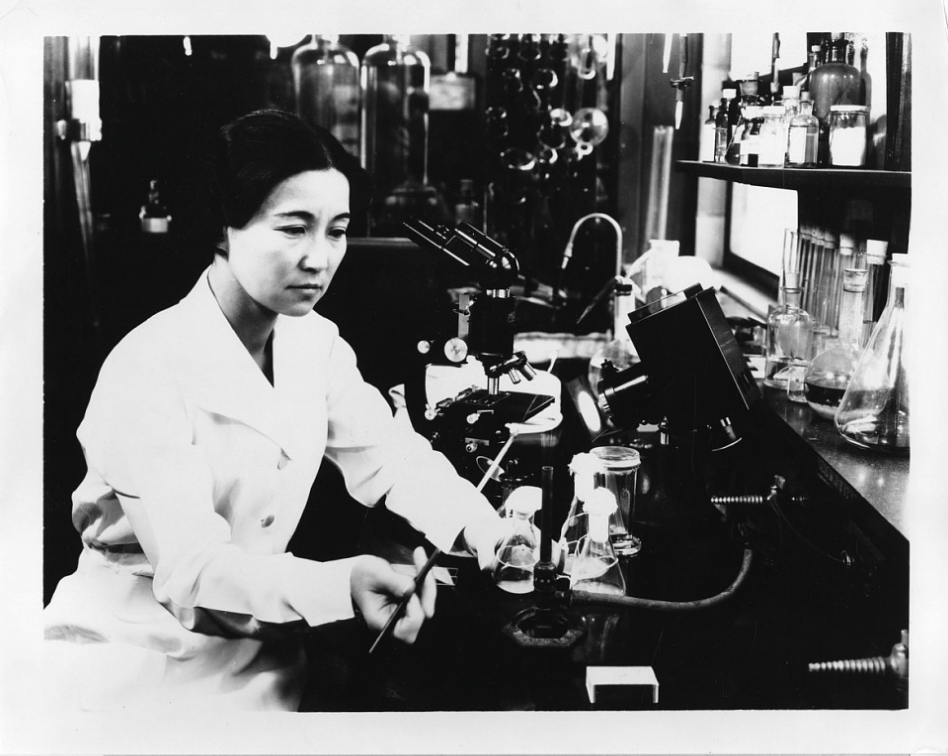
Born as a second generation immigrant to Japanese parents, in Washington in 1904, Ruby Hirose proved that despite her status, she can still do advantageous scientific work. After her parents moved from Japan to the United States, Hirose slowly began witnessing “the gradual development of anti-Japanese sentiment,” according to Emma Shimizu in Female Innovators Who Changed Our World. Afterwards, her family’s hardships slowly grew to be more difficult. Eventually, Ruby’s younger sister and mother grew ill with tuberculosis, and according to Shimizu, her sister died while Hirose attended university as well as her mother who then died shortly after.
After continuing her studies at the University of Cincinnati, Ruby began researching a coagulation factor- thrombin, which was published in the American Journal of Physiology. She worked to prove further evidence of the thrombin action, which converts soluble fibrinogen to insoluble fibrin and promotes the formation of blood clots. Hirose was, in time, one of the only two individuals awarded the Moos Fellowship in Internal Medicine. She then went on to become employed by William S. Merrell Laboratories, after earning her PhD. Her work started with the research of things such as toxins and serums, and according to Emma Shimizu, “laid the foundations for the Polio vaccine,” making her work substantial and impactful especially for children.
In addition to her previous work, Ruby also studied diphtheria, a contagious bacterial infection known to be fatal. Once again, her research led to another vaccine, this time for diphtheria, after it had been studied that the disease “could be precipitated using potassium aluminum sulphate, commonly known as alum,” as stated in Female Innovators Who Changed Our World. In society at the time, many families of Italian or Japanese descent were evacuated to internment camps. Although Hirose “experienced the identity crisis of belonging to neither the society she was born in and bred into nor the Japanese society of the first generation, or Issei,” she fortunately was not discluded from her professional community and went on to become one of the ten females of the American Chemical Society Cincinnati branch, according to Shimizu.
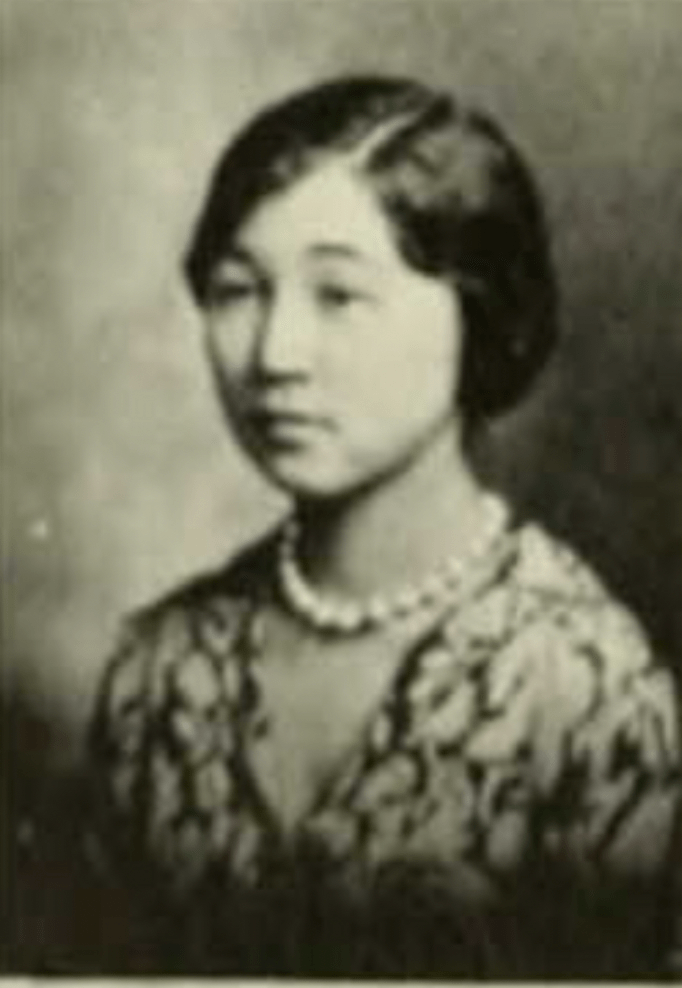
Aside from her studies regarding various infectious diseases, Hirose’s research led to her findings about how allergies affect the immune system and its triggers. Eventually, following her work, advancements of adjuvants were made, which could be added to vaccines making them stronger with a smaller dosage. Building upon such findings, Hirose discovered that alum could also be used to treat the desensitizing pollen extracts used by people with allergies. As time passed, Ruby went on to specialize in bacteriology while working in multiple hospitals during her later career.
Unfortunately, before the treaty used to improve the relationship between the U.S. and Japan was amended, Ruby Hirose sadly passed away after developing leukemia at the age of 56. Today, her scientific research and findings has proved extremely beneficial in our world, and Ruby Hirose has become a prominent figure in the realm of biochemistry. She successfully demonstrated that her demographics were “not a barrier to doing valuable scientific work that benefited people all over the world,” as said by Shimizu.
Works Cited
Shimizu, Emma. Female Innovators Who Changed Our World. Pen & Sword Books Ltd, 2022
“Ruby Hirose.” Smithsonian American Women’s History,
womenshistory.si.edu/herstory/science-innovation/object/ruby-hirose.
“Ruby S. Hirose (1904-1960) – Find a Grave…” Www.findagrave.com,
www.findagrave.com/memorial/17153380/ruby-s_-hirose. Accessed 18 June 2024.

 Her Stem Space
Leave a comment