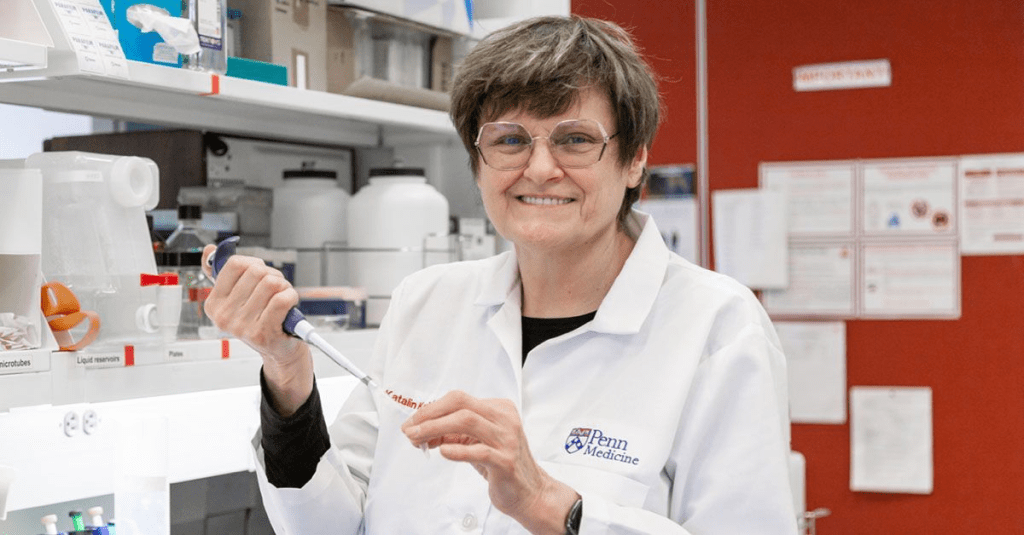
Once upon a time, in a dimly lit lab hidden within the halls of the University of Pennsylvania, a Hungarian-born immigrant woman was waging a silent war—not with weapons or politics, but with molecules, determination, and unwavering belief. Katalin Karikó, a name once scrawled in the margins of overlooked research, now stands etched in the annals of Nobel laureates. But her ascent was anything but meteoric—it was slow as molasses, marked by rejection, skepticism, and an unending series of setbacks.
Born on January 17, 1955, in Hungary, Katalin Karikó’s belief in messenger RNA (mRNA) as a therapeutic tool was considered fringe at best—delusional at worst. In an era when scientific innovation often bowed to tradition, she dared to dream that synthetic mRNA could instruct cells to make proteins and fight disease from within. The scientific world wasn’t ready. Her grants dried up, promotions eluded her, and her very presence in academia was deemed “not of faculty quality.” She was demoted, denied basic lab supplies like deionized water, and locked out of meetings. In 2013, her belongings were packed and moved without her knowledge.
But the world changed in 2020. The pandemic that brought the planet to a halt also catapulted mRNA into the spotlight. The vaccines that carried humanity out of despair—Pfizer-BioNTech and Moderna—stood tall on the very foundation Karikó and her collaborator, Dr. Drew Weissman, had laid. Together, they pioneered the biochemical modifications that stabilized mRNA and allowed it to be safely and effectively delivered into the human body. What once drew scorn became salvation.
Yet this story, triumphant as it is, marks not the end but the prelude to a greater revolution. mRNA is not merely a COVID-19 solution; it is a platform—a blueprint for medicine’s next golden age. Today, clinical trials are underway for Zika, rabies, tuberculosis, HPV, and even breast and ovarian cancers. In the pipeline lie HIV, malaria, pancreatic cancer, and genetic disorders, all awaiting the precision touch of mRNA.
This biomedical renaissance is powered not just by molecules, but by women—visionaries, geneticists, immunologists, oncologists—many of whom, like Karikó, have fought uphill battles for recognition. In the high-stakes world of clinical innovation, women are not merely participating—they are leading. mRNA therapies can be tailored to a patient’s unique genetic makeup, enabling a future where gendered health disparities may finally vanish. This is especially vital in a world where male-centric trials and treatments have historically—and often purposefully—left women behind.
Still, the gender gap in STEM persists like an outdated relic. According to UNESCO (2023), only 33.3% of researchers worldwide are women, with the numbers falling further for women of color, those in low-income nations, and those from historically marginalized groups. Funding disparities, publication biases, and exclusion from leadership roles continue to plague the field like a virus without a vaccine. But change is stirring. Karikó’s Nobel Prize in 2023 was more than an individual triumph—it was a torch passed to the next generation of women in science.
Across the globe, female scientists are shaping equitable global health policy, rethinking vaccine distribution models, and interrogating the ethics of biotech access. They are ensuring that medical breakthroughs are not hoarded by privilege but guided by compassion. These women are not only in labs—they are in boardrooms, regulatory agencies, and classrooms.
mRNA, in all its elegant complexity, is a symbol of what happens when science, persistence, and rebellion converge. And women—unfettered by dismissal, lit by purpose—are steering its future. From the sterile hum of laboratories to the thunderous applause of Nobel ceremonies, their journey is reshaping medicine and redefining who gets to be remembered as a pioneer.
So let it be known: in the story of mRNA’s rise, women are not footnotes. They are the authors of the next chapter of human health.
Works Cited
Binday, Ben. ““Not of Faculty Quality”: How Penn Mistreated Nobel Prize-Winning Researcher Katalin Karikó.” http://Www.thedp.com, http://www.thedp.com/article/2023/10/penn-katalin-kariko-university-relationship-mistreatment.
Brown, Susan, and Roopa Dhatt. “Female Leaders Are at the Forefront of COVID-19 Vaccine.” World Economic Forum, 8 Mar. 2021, http://www.weforum.org/stories/2021/03/breaking-the-glass-vial-women-at-the-forefront-of-covid-19-vaccine/. Accessed 6 May 2025.
“Female-Led Ventures Get Just 2% as Africa’s Startup Funding Dips in March 2025.” Techpoint Africa, 2 Apr. 2025, techpoint.africa/news/africas-funding-dips-march/. Accessed 6 May 2025.
Hafner, Katie, et al. “Katalin Karikó’s Nobel Prize–Winning Work on MRNA Was Long Ignored—and Led to COVID Vaccines.” Scientific American, 9 Jan. 2025, http://www.scientificamerican.com/article/katalin-karikos-nobel-prize-winning-work-on-mrna-was-long-ignored-and-led-to/.
Haque, A. “Women Lead Vaccine Development across the Industry.” Pharmacy Times, 30 Apr. 2024, http://www.pharmacytimes.com/view/women-lead-vaccine-development-across-the-industry.
“International Day of Women and Girls in Science 2021: Meet the Women Who Led the Fightback against COVID-19 | Science, Engineering & Life Science Recruitment, Jobs & Staffing.” SRG, http://www.srgtalent.com/blog/meet-the-women-leading-the-fightback-against-covid-19.
“Katalin Karikó | the National Inventors Hall of Fame.” http://Www.invent.org, 21 May 2023, http://www.invent.org/inductees/katalin-kariko.
Lloyd, Jay. ““You Learn More from Failure—When Things Are Not Working Well.”” Issues in Science and Technology, 21 Oct. 2024, issues.org/interview-katalin-kariko/.
Lowery, Tess. “13 Shocking Facts about Gender Inequality around the World.” Global Citizen, 24 Nov. 2023, http://www.globalcitizen.org/en/content/shocking-facts-gender-inequality-international-wom/.
NIH. “Nobel Prize Awarded for Research Leading to MRNA COVID-19 Vaccines | NIAID: National Institute of Allergy and Infectious Diseases.” http://Www.niaid.nih.gov, 31 Oct. 2023, http://www.niaid.nih.gov/news-events/nobel-prize-awarded-research-leading-mrna-covid-19-vaccines.
“One in Three Researchers Is a Woman | UNESCO.” http://Www.unesco.org, http://www.unesco.org/en/articles/one-three-researchers-woman.
Penn Medicine. “Katalin Kariko, PhD.” Pennmedicine.org, 2022, http://www.pennmedicine.org/providers/profile/katalin-kariko.
Pollock, Isaac. “Penn Sues BioNTech, Seeks “Full Royalty Payments” for COVID-19 Vaccine.” Thedp.com, The DP, 2024, http://www.thedp.com/article/2024/08/penn-sues-biontech-covid-vaccine-royalties. Accessed 6 May 2025.
profile. “Women in MRNA Research: Inspiring Stories of Female Scientists Pioneering the Field.” Seclifesciences.com, 2023, http://www.seclifesciences.com/blog/women-in-mrna-research–inspiring-stories-of-female-scientists-pioneering-the-field/. Accessed 6 May 2025.
The Nobel Prize. “The Nobel Prize in Physiology or Medicine 2023.” NobelPrize.org, 2 Oct. 2023, http://www.nobelprize.org/prizes/medicine/2023/press-release/.
UN Women. “Facts & Figures.” UN Women, 2012, http://www.unwomen.org/en/news/in-focus/commission-on-the-status-of-women-2012/facts-and-figures.
“Women in Science Who Are Making a Difference during the Pandemic.” UN Women, http://www.unwomen.org/en/news/stories/2021/2/compilation-women-in-science-leading-during-the-pandemic.
University of California San Diego. “Nierenberg Prize Awarded to Biochemist Katalin Karikó for Pioneering Research on COVID-19 Vaccines.” UC San Diego Today, 6 Nov. 2023, https://today.ucsd.edu/story/nierenberg-prize-awarded-to-biochemist-katalin-kariko-for-pioneering-research-on-covid-19-vaccines.
About the Author

Hi! My name is Fatima Boganee and I’m 17 years old. I live in Mauritius and plan to work in biology when I’m older!

 Her Stem Space
Leave a comment