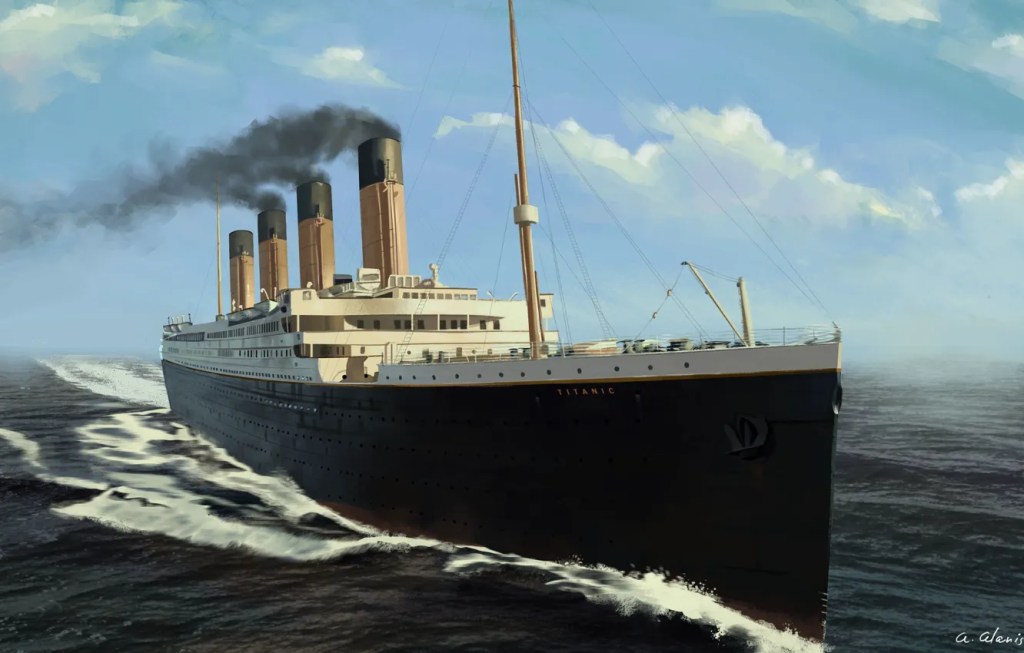
Perhaps the most legendary shipwreck of all, the RMS Titanic sailed and sank on its maiden voyage over a century ago. Thanks to the cinematic efforts of James Cameron, Titanic remains in popular culture today–no cruise goer can escape the iconic pose of Jack and Rose at the bow, and no movie critic can deny the 1997 blockbuster’s unparalleled impact.
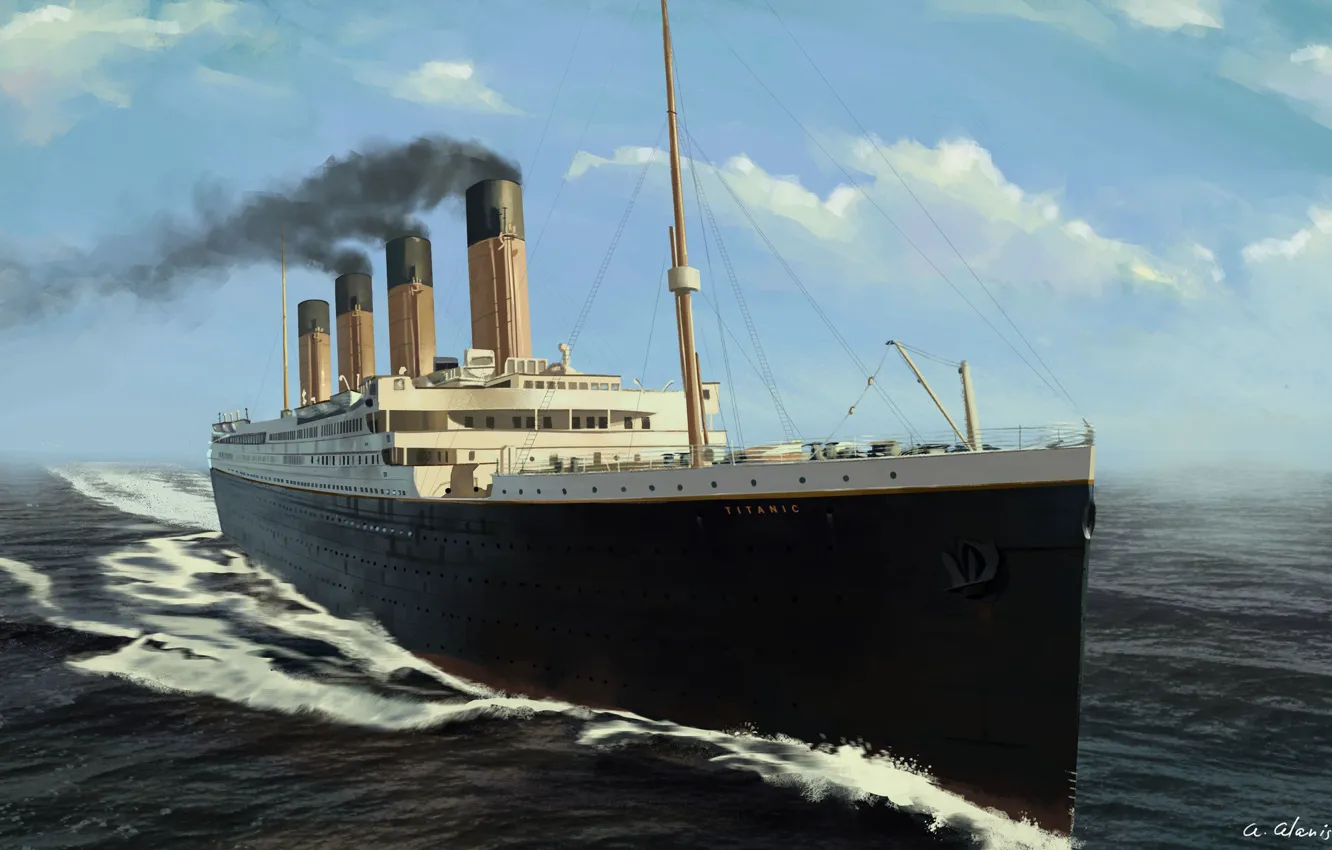
However, beyond tumultuous movie scenes and basic facts, most are unaware of the true story. The facts behind the fame. The science of the sinking.
The night of April 14, 1912, is eerily dark and unusually calm. The water, described as “glass-like” by survivors, is more of a curse than a blessing–with no breaking water at the base, icebergs will be much harder to spot. It’s noticeably colder, too, with the air temperature around 32 F (0 C), and the water even colder at 28 F (-2.2 C).
A flurry of factors, all trivial on their own but catastrophic once compiled–a lack of binoculars and moonlight, a fast sailing speed of 22.5 knots (26 mph; 41 km/h), and the deceptive shape of the iceberg–conceal danger on the horizon. And at exactly 11:40 pm, 400 miles north of Newfoundland, Canada, the massive steamliner and its icy counterpart collide.
The jagged edges of the berg scrape along Titanic’s starboard (right) side, tearing open the hull of the ship. The ship’s steel has a high sulfur content, which, when combined with frosty North Atlantic temperatures, transforms it from ductile (flexible) to brittle. The watertight compartments fill rapidly, and while the ship can stay afloat with four of the sixteen breached, the damage is so severe that five are immediately submerged. Soon, everything is sealed, but it’s too late. Titanic will sink; it’s a mathematical certainty.
The bow, or front of the ship, is immediately pulled downward by the water weight. The port, or left side of the ship, visibly lists toward the ocean, accelerating the overflow onto the deck. At this point, third-class passengers are noticing water accumulating and rising in their corridors. Soon enough, the entire bow dips beneath the surface, engulfing the front and belly of the vessel.
The four massive boilers begin to collapse, toppling over into the sea and exacerbating the downward pull. For avid fans of the movie, the scene where Jack and Rose rush to the stern occurs now as the lights flicker off, plunging them into pitch darkness.
Stress between the bow and stern builds to a maximum, resulting in the ship snapping in half. The bow plunges straight down, leaving Titanic’s rear to flounder on the surface. It strikes the seabed, force crumpling its back slightly like an accordion.
Meanwhile, the stern assumes a vertical tilt–for reference, when Jack and Rose prepare to jump free–and plummets upright before spiraling backward, its back end initially flattening into the seafloor as the rest crashes down. As both halves of the ship descend, components like shell plating and double bottoms are forcibly stripped off by the pressure of the fall.
The time is now 2:56 am. About 2 hours and 40 minutes have passed, and the once-mighty ocean liner that broke records for its largeness and luxury lies in pieces on the seafloor. Over 1,500 souls are lost, the majority being impoverished passengers and men who were deprioritized for lifeboats. The 20 lifeboats aboard Titanic could seat 1,178 people–barely half of the total population. The lack of emergency vessels is due to the Merchant Shipping Act of 1894, which required ships over 10,000 tons to carry at least 16 lifeboats–an outdated rule for the 45,000 ton Titanic. And even these aren’t filled to capacity, with the survivor count totaling around 705, or just 33% of the people onboard who endured–and lived on.
It’s easy to look back on Titanic as a spectacle, shrouded in romance and mystery. In truth, it was a wreck of catastrophic proportions. Hundreds died, and even more were injured or abandoned. Let the loss serve as a lesson: for caution, for safety, for science and common sense. And let all impacted by its plunge rest in peace.
Works Cited
Ferrell, Jesse. “Weather maps from the night the Titanic sank.” AccuWeather, 12 April 2022, https://www.accuweather.com/en/weather-blogs/weathermatrix/weather-maps-from-the-night-the-titanic-sank/1173542. Accessed 29 June 2025.
“How many people died when the Titanic sank?” Britannica, https://www.britannica.com/question/How-many-people-died-when-the-Titanic-sank. Accessed 29 June 2025.
“The Iceberg that Sank Titanic | National Museum of American History.” National Museum of American History, https://americanhistory.si.edu/collections/object/nmah_1416178. Accessed 29 June 2025.
Lowndes, Coleman. “Why the Titanic didn’t have enough lifeboats.” Vox, 6 February 2023, https://www.vox.com/videos/23587972/titanic-lifeboats-disaster-safety-regulation-solas. Accessed 29 June 2025.
“New CGI of How Titanic Sank | Titanic 100.” YouTube, 5 April 2012, https://www.youtube.com/watch?v=FSGeskFzE0s. Accessed 29 June 2025.
Tikkanen, Amy. “Titanic | History, Sinking, Survivors, Movies, Exploration, & Facts.” Britannica, 25 June 2025, https://www.britannica.com/topic/Titanic. Accessed 29 June 2025.
“Titanic sinks | April 15, 1912 | HISTORY.” History.com, https://www.history.com/this-day-in-history/april-15/titanic-sinks. Accessed 29 June 2025.
“What temperature was the air the night the Titanic sank? I googled this but all I can find is the temperature of the water (28°). I can’t find anything on the temperature of the air.” Quora, 18 October 2020, https://www.quora.com/What-temperature-was-the-air-the-night-the-Titanic-sank-I-googled-this-but-all-I-can-find-is-the-temperature-of-the-water-28-I-can-t-find-anything-on-the-temperature-of-the-air. Accessed 29 June 2025.
About the Author
Anjana is interested in medicine and developing fields within it, especially antimicrobial resistance. She is passionate about reading and writing, and merging words and healthcare in an empowering way is her life’s goal.


 Her Stem Space
Leave a comment