Medical terminology is one of the most alluring aspects of health shows, a crucial part of med school, and a convenient method of communication in the field. When a nurse labels a patient as “tachycardic,” regardless of whether they’re in the United States or Switzerland, in English or Albanian, it is understood to mean a rapid heart rate. When a medical assistant measures a patient’s blood pressure above 120/80, they’re flagged as “hypertensive” from Shanghai to Texas. A clear indicator of success is when a system works for anyone, anywhere, at any time, and that’s exactly what terminology illustrates.
Medical terminology originated over 2,000 years ago in the writings of Greek physician Hippocrates, often coined the “father of medicine.” According to Edmund Andrews in A History of Scientific English (2012), over 70% of modern medical English can be traced back to this time period.
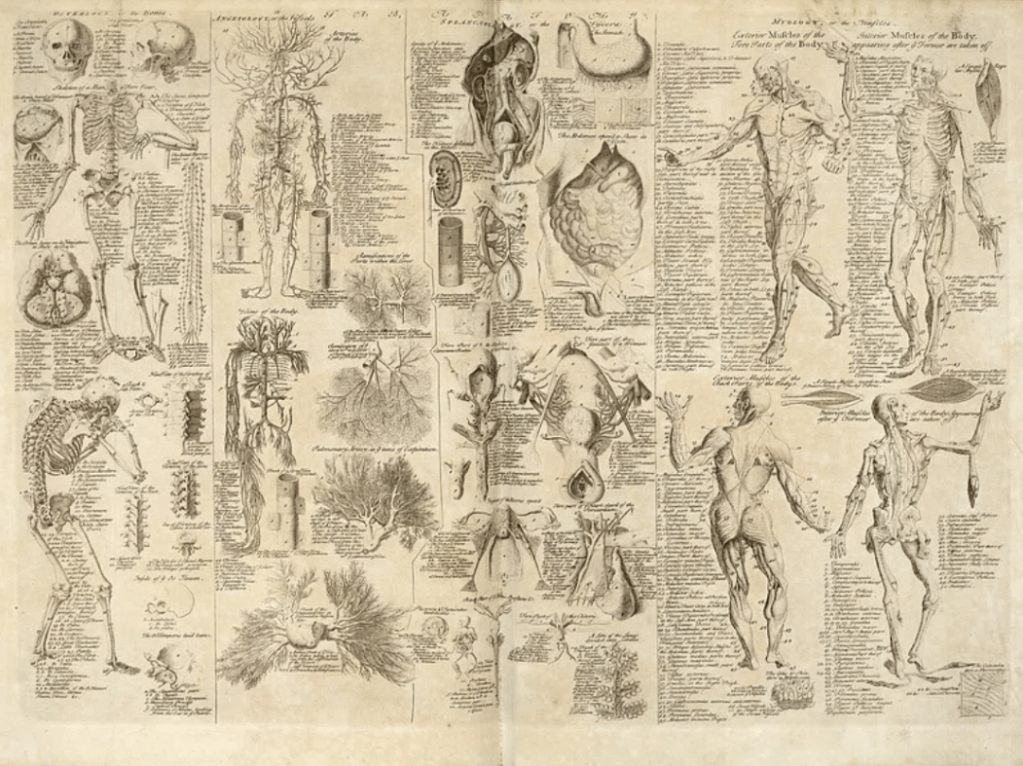
The source Hippocrates used is unknown, but some hypothesize that many words were translated to Greek from Egyptian.
Terms varied in degrees of technicality and permanence. For example, anatomic parts were oftentimes labeled for everyday objects they resembled (the acetabulum, or hip socket, was named for a vinegar cup). And, as the Greek medical vocabulary bled into Rome, words such as “perikardion” were Latinized, becoming the more familiar “pericardium.”

However, the timeline for linguistic progress is not linear. Classical Greek and Roman empires underwent a dark period soon after the first few centuries A.D. in which many medical texts were lost, some terms preserved only through monks’ writings.
Their current existence is due to the translation of ancient Greek texts into Arabic in the 9th century by Islamic scholars, and their revival in the sixteenth-century Renaissance.
As the years progressed, terms were altered from Greek to Latin to French with the expansion of European empires, and eventually to English when it was brought to America. New words were created as medical discoveries were made, such as “anaphylaxis” in the early 20th century. As words assimilated into the vernacular, they adopted more colloquial forms (“palsy” from “paralysis” and “flu” from “influenza” to name a few).
Today, over 250,000 medical terms are estimated to exist. The SNOMED-CT (Systematized Nomenclature of Medicine–Clinical Terms) is the most comprehensive collection of them, and it boasts over 344,000 entries and 90,000 synonyms. Everything from the recognizable “arthritis”–joint inflammation–to the appalling “sphenopalatine ganglioneuralgia”–brain freeze–has a place and purpose.
Medical terminology is a joint effort–of the ancient Greeks and Romans, the intellectual Islamic empires, the innovative Italians, British, and French. It is so much more than prefixes and suffixes; it is the world collaborating and cooperating, sharing information in the pursuit of perhaps the most important goal: saving lives.
Works Cited
A review of medical terminology standards and structured reporting, https://pmc.ncbi.nlm.nih.gov/articles/PMC6504145/. Accessed 22 June 2025.
Litzinger, Mary, and Glen Levin Swiggett. ““Studies in Anaphylaxis”—The First Article in The Journal of Immunology.” The American Association of Immunologists, https://www.aai.org/About/History/History-Articles-Keep-for-Hierarchy/Studies-in-Anaphylaxis%E2%80%9D%E2%80%94The-First-Article-in-The. Accessed 22 June 2025.
McIntosh, Dan. “History of Medical Terminology.” OpenMD, https://openmd.com/guide/history-of-medical-terminology. Accessed 22 June 2025.
Vagelpohl, Uwe. “Dating Medical Translations.” Journal of Abbasid Studies, vol. 2, no. 1, July 2015, pp. 86–106, doi:10.1163/22142371-12340015.
About the Author
Anjana is interested in medicine and developing fields within it, especially antimicrobial resistance. She is passionate about reading and writing, and merging words and healthcare in an empowering way is her life’s goal.


 Her Stem Space
Leave a comment