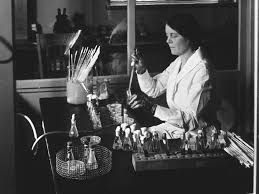

When we think of women in science, names like Marie Curie or Rosalind Franklin often come to mind. However, there are many more pioneers who deserve recognition for their groundbreaking work and perseverance in a male-dominated field. One such figure is Dr. Ida A. Bengston, the first woman Ph.D to be employed at the National Institutes of Health (NIH), then known as the Hygienic Laboratory of United States Public Health Service. Her story is one of innovation, resilience, and trailblazing.
EARLY LIFE
Ida. A. Bengston was born in 1881 to Swedish immigrant parents born in Harvard, Nebraska. Growing up in a small town, Bengston didn’t initially set out to revolutionize the field of bacteriology. She pursued a degree in mathematics and languages from the University of Nebraska, graduating in 1903. Her journey into science wasn’t linear; like many students today, she switched career paths. She initially worked as a cataloguer at the U.S Geological Survey but found the work unfulfilling. On the advice of a friend, Bengston decided to go back to school, this time perusing an M.S. and Ph.D. in bacteriology from the University of Chicago. This shift marked the beginning of her significant contributions to the medical field.
At the time, there were very few women entering scientific fields, but Bengston’s decision to change her career path reflected her drive to make a meaningful impact. The choice to focus on bacteriology was also an exciting one, as it was a cutting-edge area of research with the potential to transform public health.
JOINING THE NIH
In 1916, Dr. Bengston was hired by the Hygienic Laboratory, becoming the first female Ph.D. employed at what would later become the NIH. At the time, the idea of women working as scientists was not widely accepted, but Bengston’s appointment was a sign of change. Her success in this role not only paved the way for other women but also showcased the valuable contributions women could make in the field of scientific research. In fact, within the next two decades, 10 more women were hired at the laboratory, thanks in part to Bengston’s influence and outstanding work.
This milestone is especially significant when we consider the societal expectations of women in the early 1900s. Women were often expected to take on more traditional roles, but Bengston’s career was proof that women could excel in the highest levels of scientific research. Her ability to “fill her position so ably” also challenged stereotypes and demonstrated that women could be leaders in the scientific community.
RESEARCH AND CONTRIBUTIONS
Dr. Bengston quickly proved her worth in the field of bacteriology. Just one year after joining the Hygienic Laboratory, she made a groundbreaking discovery that linked an outbreak of tetanus in the U.S. to contaminated vaccine scarifiers. This discovery was critical at the time when the country was struggling with public health issues and laid the foundation for her impressive career. She was frequently moved around the country to help address urgent medical problems, demonstrating her expertise and commitment to public health.
But this was just the beginning. Throughout her 30-year career, Bengtson made significant strides in understanding infectious diseases, including typhus, Rocky Mountain spotted fever, Q fever, and botulism. She played a key role in helping to develop the typhus vaccine, a life-saving advancement during World War II when the disease was a significant threat to troops. These contributions not only improved the health of communities but also solidified her status as one of the country’s leading bacteriologists.
Perhaps one of her most enduring contributions is the development of the complement fixation test, a diagnostic method that is still in use today to detect and differentiate rickettsial diseases. This test allowed doctors to identify diseases spread by ticks, mites, fleas, and lice, making it easier to combat these deadly illnesses.
The fact that her methods are still in use today shows just how impactful her work was, even long after her retirement. Bengtson was always ahead of her time, making discoveries that would influence medicine for generations.
PERSONAL SACRIFICE FOR SCIENCE
The work Dr. Bengtson did was not without risk. While studying and handling dangerous diseases, she contracted typhus herself. Despite this, she continued her work with an unwavering commitment to science and public health. This kind of dedication serves as a powerful reminder of the challenges that scientists, especially women, faced during this time. Contracting a dangerous disease as part of her job showed the personal sacrifices that came with her research. Bengtson’s perseverance, even after facing serious health risks, showed her dedication to making the world a healthier and better place. Her story shows that passion for science often means overcoming obstacles and facing risks, even when the personal cost is high.
HER LEGACY
Dr. Bengtson’s legacy extends beyond her scientific achievements. She is a role model for young women who aspire to break into the male-dominated fields of science, technology, engineering, and mathematics. Her ability to excel in a time when women were largely underrepresented in scientific fields is proof to her talent, hard work, and determination. Bengtson didn’t just make scientific breakthroughs. She opened doors for future generations of female scientists. Her work serves as a reminder of what women can accomplish.
By the time she retired, Dr. Bengtson had helped lay the foundation for modern bacteriology. Her work saved countless lives and contributed to the advancement of medical science in ways that are still felt today. In fact, at the time of her retirement, an Associated Press Science reporter referred to her as one of two “heroines of science,” a fitting title for someone who had given so much to the field. Bengtson’s story also us of the importance of recognizing women’s contributions to science. She and other women like her are key figures in public health history, though their names may not be as well known as others.
Works Cited
bioMérieux Connection. “Ida A Bengston and Alice Evans: Heroines of Science and Bacteriology.” bioMérieux Connection, 4 Mar. 2021, http://www.biomerieuxconnection.com/2021/03/04/ida-a-bengston-and-alice-evans-heroines-of-science-and-bacteriology/.
Missouri S&T. “NIH’s First Woman Scientist.” 150 Years of Miner Excellence, 2018, 150.mst.edu/stories/innovation-and-invention/nihs-first-woman-scientist/.
National Institutes of Health. “Ida A. Bengtson.” Office of NIH History and Stetten Museum, https://history.nih.gov/display/history/Bengtson%2C+Ida.
About the Author
Hi! My name is Daniela Gonzalez and I am a sophomore from Texas. I am passionate about virology and space science, and I hope to encourage other girls to explore STEM!


 Her Stem Space
Leave a comment