In June of 2023, the world watched as a deep-sea expedition to the wreckage of the Titanic catastrophically failed. The OceanGate Titan submersible, carrying 5 passengers, including the company’s CEO Stockton Rush, imploded under the immense pressure of the Atlantic Ocean.
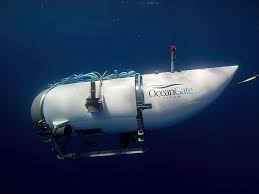
Approximately 90 minutes into the descent of the Titan submersible, off the coast of Newfoundland, Canada, the vessel lost all contact with the outside world. After a four-day, international search and rescue operation, debris from the sub was recovered, confirming the worst.
In the weeks that followed, experts and engineers began investigating.
What they discovered suggested that this wasn’t just some tragic accident, it was the result of flawed design, ignored warnings, untested materials, and a deliberate disregard of safety protocols regulations and protocols. Ex-OceanGate consultant Rob McCallum claims that the failure of the Titan submersible was a “mathematical certainty.”
The primary issue with the submersible was its use of unconventional materials. The cylindrical hull of Titan was made almost entirely out of carbon fibres. Typically praised for its dynamic ability to be lightweight yet maintain immense strength, the popularity of carbon fibre has been on the rise in the aerospace industry; however, its use in high pressure environments, such as deep-sea engineering, remains controversial.
The wreckage of the Titanic sits at about 3,800 meters deep; that’s 12,500 feet or roughly 9 Empire State buildings below sea level. At such depth, the pressure reaches over 5,500 pounds per square inch (psi); that’s 370 times more than the average 14.7 psi we experience at sea level. In such an environment, even the smallest structural weaknesses can have fatal consequences. To ensure safety in a submersible, it’s essential that all materials are thoroughly tested and certified for use in deep-sea conditions. There is little to no margin for error when the stakes are so high.
Standard industrial submersibles are built using materials like titanium, or specially treated steel or aluminum; these materials have undergone decades of rigorous testing, and have been formally certified as safe for use at extreme depths. OceanGate, however, chose to ignore these norms and opt for the unconventional carbon fibre instead.
Various experts and deep-sea engineering specialists voiced their concerns over the lack of testing and certification of the unconventional Titan submersible.

Among them was OceanGate’s very own director of marine operations, David Lochridge, who filed a formal report detailing numerous safety concerns, including doubts over the structural integrity of the hull and the lack of proper stress testing.
Rather than looking into these concerns, OceanGate silenced its critics and proceeded to fire Lochridge. In a bold reflection of the company’s mindset, CEO Stockton Rush stated, “I don’t want anybody in this company that is uncomfortable with what we’re doing…I’m not going to force people to join my religion.”
At OceanGate, they believed that innovation required risk, and that traditional regulations held back progress. By labeling the Titan submersible as “experimental” in all official documentation and legal paperwork, the company was able to bypass key regulatory requirements and avoid third-party certification. This loophole allowed OceanGate to operate outside the oversight of maritime safety organizations and avoid the kind of accountability that most deep-sea missions are held to.
The implosion of Titan wasn’t just a failure of engineering; it was a failure of accountability. Warnings were given, concerns were raised, and yet OceanGate remained dismissive throughout, moving forward with the innovation they believed was worth the risk. But in environments as unforgiving as 3,800 meters under the ocean, there is no room for shortcuts. What happened with Titan was no mystery; it was the inevitable result of treating safety as secondary and science as negotiable.
Exploration should push limits, but it shouldn’t cross them blindly.
Works Cited
Anderson, James. “Was the OceanGate Sub Implosion an Engineering Failure?” Engineering.com, 11 July 2023, http://www.engineering.com/was-the-oceangate-sub-implosion-an-engineering-failure/.
Monroe, Mark, director. Titan: The OceanGate Submersible Disaster. Netflix, 2025.
O’Kane, Caitlin. “U.S. A look at Titanic wreck ocean depth and water pressure ? and how they compare to the deep sea as a whole.” CBS News, 23 June 2023, http://www.cbsnews.com/news/titanic-sub-debris-near-titan-ocean-depth-pressure-of-deep-sea/.
Pogue, David. “A second Titanic tragedy: The failure of OceanGate’s Titan.” CBS News, 25 June 2023, http://www.cbsnews.com/news/titanic-tragedy-the-failure-of-oceangate-submersible-titan/.
Treisman, Rachel. “Experts raised safety concerns about OceanGate years before its Titanic sub vanished.” NPR, 21 June 2023, http://www.npr.org/2023/06/21/1183408455/titan-missing-submarine-oceangate-submersible.
About the Author:

Hi! My name is Maira and I’m a rising junior in high school from Karachi, Pakistan with a passion for all things STEM. Whether that be space, neuroscience, or just the simple science behind everyday experiences, I’m endlessly curious about how the world works. I aspire to one day pursue a career in STEM and want to inspire girls around me to one day seem themselves doing the same.


 Her Stem Space
Leave a comment