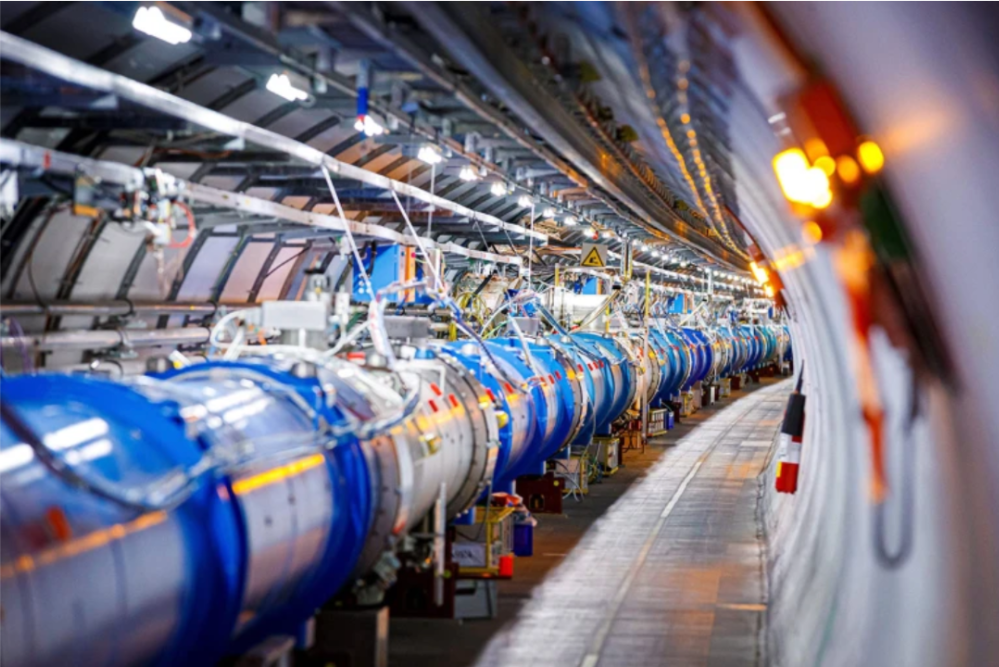
Nestled beneath the border between Switzerland and France near Geneva, lies one of the world’s most key laboratories in the field of physics and particle physics – CERN (the European Organization for Nuclear Research). Home to the world’s most powerful particle accelerator, the Large Hadron Collider (LHC). For decades, CERN has stood at the forefront of particle physics, playing a central role in some of the most significant scientific breakthroughs of our time. From confirming the existence of the Higgs boson in 2012 to developing revolutionary technologies that extend far beyond physics, CERN has become a symbol of human ingenuity and collaboration. Its mission is bold: to explore the nature of matter, the forces that govern it, and the deepest mysteries of our universe.
At the heart of this effort is the LHC, a 27-kilometer underground ring that accelerates protons to approximately 99.9999991% of the speed of light before colliding them together. LHC utilizes 4 main detectors – ATLAS, CMS, ALICE, and LHCb, which observe, analyse and record the aftermath of the particle collision, giving scientists glimpses into the smallest, fundamental particles and the way that they are broken down. Since its restart in 2022 from a three-year hiatus, the LHC has been running at record energies, but even bigger changes are coming for future research. The upcoming High-Luminosity LHC (HL-LHC), set to launch later this decade (2030), will dramatically increase the number of collisions, allowing scientists to study rare phenomena and refine measurements of known particles with unparalleled precision, such as the Higgs boson.
CERN’s vision extends well beyond the LHC. Plans for the Future Circular Collider (FCC) aim to create a 90.7-kilometer ring capable of collisions significantly more powerful than LHC’s energy. The FCC could unlock answers about dark matter, dark energy, and the unification of nature’s forces. Many scenarios of these questions and answers suggest the existence of heavier particles, far beyond the reach of the original LHC, calling for higher-energy facilities. Others suggest the existence of lighter particles that interact weakly with Standard Model particles and whose detection requires large amounts of data to be analysed and more sensitivity diverted to their production. The €17 billion FCC will combine those talents and bring forward a programme that would allow physicists to explore this landscape of possibilities in full. On the other hand, other projects from CERN include the Compact Linear Collider (CLIC), a linear accelerator designed for ultra-precise measurements, and the Large Hadron-electron Collider (LHeC), which would collide high-energy electrons with the LHC’s protons or heavy ion beams for new insights in mapping the internal structure of protons and nuclei. In parallel, the Advanced Wakefield Experiment (AWAKE) is developing plasma-based accelerators that could make future machines smaller, cheaper, and more efficient.
CERN’s contributions reach far beyond physics. The lab is pioneering ultra-efficient klystrons – radio-frequency power sources with over 80% efficiency, that could transform both research and industry. Its Worldwide LHC Computing Grid, connecting over 170 sites globally in 42 countries, processes immense volumes of data for physicists in real time. In quantum research, CERN’s BASE experiment recently created the first antimatter qubit, holding an antiproton (the antimatter counterpart of a proton) in quantum superposition for nearly a minute- an achievement that could help solve why the universe favors matter over antimatter.
All of this is guided by the European Strategy for Particle Physics (ESPP), which prioritizes both large-scale projects and diverse research programs. This collaborative vision underscores CERN’s role as not just a research center, but also a hub of international cooperation and innovation.
Every experiment, upgrade, and discovery at CERN brings us closer to answering fundamental questions: What is the nature of dark matter? Why does matter exist at all? How do the universe’s forces connect? By uniting countries, technology, and curiosity, CERN continues to expand the boundaries of human knowledge, pushing us toward a deeper understanding of the cosmos and our place within it.

About the Author:

Hi! My name is Sofiya, and I’m a rising junior in high school from Seattle, Washington. I’m passionate about physics and astrophysics, and my dream is to one day get my PhD in this field. I love dedicating my time to encouraging young women to pursue careers in STEM, and opening up more avenues for them as well!

 Her Stem Space
Leave a comment