When we think of groundbreaking moments in computing history, places like Silicon Valley or Route 128 immediately come to mind. Yet one of the most influential milestones in cybersecurity began thousands of miles away from the world’s major technology hubs, at a small computer store in Lahore, Pakistan.

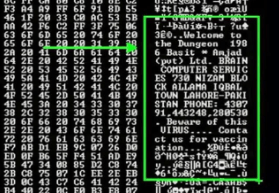
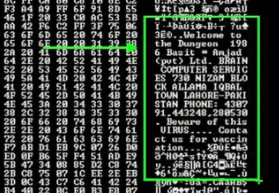
In 1986, the Alvi Brothers, Basit and Amjad, unknowingly made history when they created the first ever personal computer (PC) virus: Brain. Unlike the malicious malware we associated with computer viruses today, the brain was not created with such intent making it one of the most sophisticated computer viruses ever developed. Instead it served as an early form of copyright protection, helping the brothers combat the growing problem of software piracy they faced with the medical software developed and sold at their store. In fact, the brothers even included their names, address, and phone number within the code itself, inviting users to contact them if they encountered any issues. This unusual transparency reflected their original goal: protecting their software rather than causing harm.
However, what started out as a local solution soon became a global problem.
Back then, many computers used floppy disks to store programs and files. When a PC was switched on, it first accessed the boot sector of the floppy disk to start up before beginning any other processes. Brain took advantage of this, hiding itself in the boot sector, waiting for someone to start their computer using an infected disk before loading the virus into its memory.
Once activated, Brain could quietly copy itself onto other floppy disks inserted into the same computer. Since people frequently shared disks with friends, schools, and businesses, the virus traveled from computer to computer and eventually from country to country.
Soon enough, the Alvi brother began receiving endless phone calls from countries they had never visited, asking how to remove the mysterious program.
The unexpected spread of the brain revealed something that the world at this time hadn’t considered before: software can transfer between computers just as fast as information could. This realization helped spark the field of cybersecurity and highlighted the need for digital protection in an increasingly interconnected world.
Today, Brain remains an important chapter in the history of computing technologies. More importantly, however, it serves as a reminder that innovation knows no borders, just a curious mind and a bright idea.
Works Cited
“Brain: Searching for the First PC Virus in Pakistan.” YouTube, uploaded by WithSecure, 9 Mar. 2011, youtu.be/lnedOWfPKT0?si=DpSs9MymLRUzcBaq.
Elmer-DeWitt, Philip. “Technology: You Must Be Punished.” TIME USA, 26 Sept. 1988, time.com/archive/6713325/technology-you-must-be-punished/.
Hasan, Saad. “The making of the first computer virus — the Pakistani Brain.” TRT World, 18 Dec. 2019, http://www.trtworld.com/article/12731383?_rt=1.
IT, Ange. “Brain: the world’s first computer virus.” Medium, 1 Feb. 2023, medium.com/geekculture/brain-the-worlds-first-computer-virus-f3758323d894.
“The World’s First Computer Virus Was Created in Pakistan | Infermation.” YouTube, uploaded by Infer, 18 Dec. 2024, youtu.be/aVYU75usRpo?si=3UfXKI2X2pDV9_VF.
About the Author

Hi! My name is Maira and I’m a rising senior in high school from Karachi, Pakistan with a passion for all things STEM. Whether that be maths, physics, or just the simple science behind everyday experiences, I’m endlessly curious about how the world works. I aspire to one day pursue a career in STEM and want to inspire girls around me to one day seem themselves doing the same.
 Her Stem Space
Leave a comment