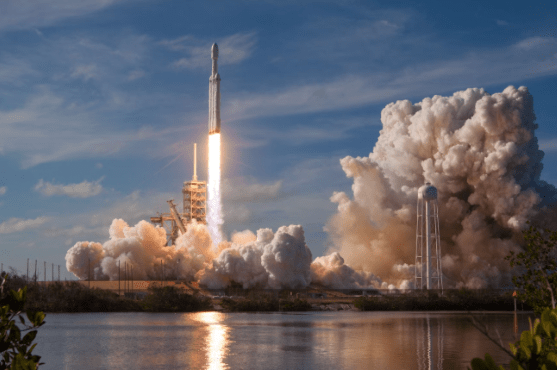
For decades, humanity has looked at the moon as a historical milestone, a place where we once left footprints during the Apollo missions. Today, however, the global aerospace community is embarking on a much more ambitious journey. Through NASA’s Artemis program, the objective has shifted from a short visit to establishing a sustainable, long-term human presence on the lunar surface. Achieving this goal requires pushing the absolute boundaries of aerospace engineering. To understand the immense logistical hurdles of long-term space habitation, we must look closely at the physics governing the machines built to overcome Earth’s gravitational pull: NASA’s Space Launch System (SLS) and innovations such as SpaceX’s Starship.
Part 1: The Raw Physics of Escape Velocity and Thrust
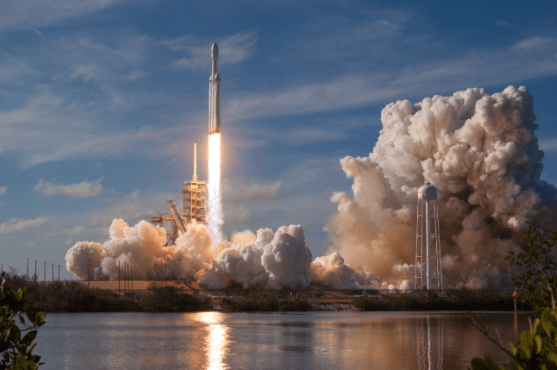
To truly appreciate the engineering behind modern rocketry, one must first understand the fundamental hurdle imposed by Earth’s gravity. Escaping our atmosphere requires a spacecraft to achieve escape velocity, or the minimum speed needed for a non-propelled body to escape from the gravitational influence of a body. For Earth, this speed is set at around 11.2 km/s (NASA). Propelling a massive vehicle to this speed relies directly on Newton’s Third Law of Motion: every action has an equal and opposite reaction. By expelling high-velocity gas mass downward through chemical combustion, the rocket receives an upward thrust force (F), calculated through the fundamental thrust equation (Hall):
F= mve + (pe-pa) Ae
Where:
- M represents the mass flow rate of the exhaust.
- Ve represents the effective exhaust velocity.
- Pe and Pa represent the pressures at the nozzle exit and in the ambient atmosphere, respectively.
- Ae is the exit area of the exhaust nozzle.
The ultimate logistical challenge of spaceflight is dictating the structural layout around the Tsiolkovsky Rocket Equation (Wikipedia). Because rocket propellant is incredibly heavy, a vehicle requires more fuel just to lift its own fuel. Breaking this compounding loop requires in depth precision in chemical propulsion and material staging.
Part 2: Deconstructing the Space Launch System (SLS)
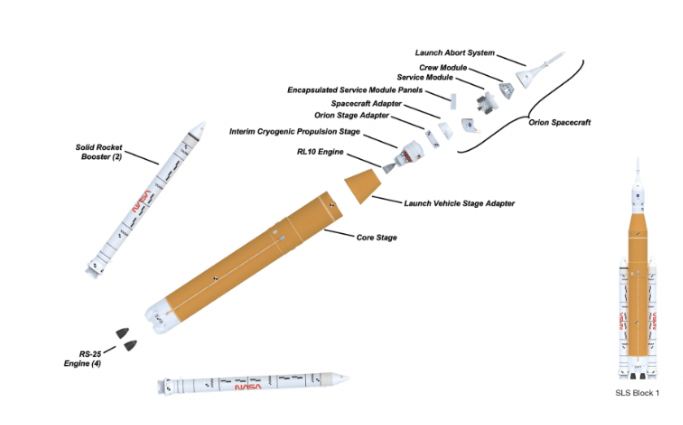
NASA’s primary vehicle for deep-space transport is the Space Launch System (SLS), a colossal heavy-lift rocket designed to carry the Orion spacecraft (“Space Launch System”). The technical complexities of the SLS core stage layout rely on balancing two distinct types of propulsion systems to optimise atmospheric ascent:
- Solid Rocket Boosters (SRBs): The twin, white five-segment boosters mounted to the sides of the rocket provide over 75% of the total initial thrust during the first two minutes of launch (“Space Launch System”). Solid fuel provides the immediate, massive thrust necessary to punch the heavy vehicle through the thickest, lowest layers of Earth’s atmosphere.
- The Core Stage Liquid Propulsion: The giant orange center tank holds cryogenic liquid hydrogen (LH2) as the fuel and liquid oxygen (LOX) as the oxidiser (“Space Launch System”). Liquid propulsion systems are highly efficient and easy to control, allowing flight computers to throttle the core engines and precisely manage the rocket’s trajectory once it enters the thinner upper atmosphere.
However, from a sustainability standpoint, the SLS faces a major logistical critique: it is an expendable launch system. Each multi-billion-dollar core stage and booster set is used exactly once before being discarded into the ocean, representing a massive material investment for every mission (National Research Council).
Part 3: Starship and the Pivot to Complete Reusability
In contrast to the proven, heavy-lift expendable philosophy of the SLS, commercial innovations, most notably SpaceX’s Starship, are attempting a radical pivot in aerospace logistics: 100% rapid reusability (Seedhouse).
To shift the economics of sustainable space exploration, Starship utilises a different propellant mixture known as methalox (liquid methane and liquid oxygen) (“Starship”). Engineering a rocket around methane introduces unusual chemical advantages:
- Methane burns significantly cleaner than traditional solid petroleum fuels, preventing heavy carbon buildup inside the complex machinery (“Starship”).
- This clean burn is vital because it allows the Raptor engines to be recovered, refueled, and refired immediately without undergoing a months-long teardown and cleaning process (Seedhouse).
By engineering a system where both the massive booster and the spacecraft can autonomously land back on Earth, the logistical equation changes. Reusability slashes the financial barriers of escaping Earth’s gravity, paving the way for the continuous transport of supplies needed for long-term space habitation (“Starship”).
Works Cited
NASA. “Space Launch System (SLS) Core Stage.” NASA, Aug. 2025, www.nasa.gov/reference/space-launch-system/ Accessed 31 May 2026.
National Research Council. Pathways to Exploration: Rationales and Approaches for a Spaceflight Program. The National Academies Press, 2014, doi:10.17226/18805
Seedhouse, Erik. SpaceX’s Starship: The Ultimate Heavy-Lift Rocket. Praxis Publishing, 2024.
SpaceX. “Starship: Capabilities and Propellant Economics.” SpaceX, 2025, www.spacex.com/vehicles/starship/. Accessed 31 May 2026.
Wikipedia Contributors. “Tsiolkovsky Rocket Equation.” Wikipedia, Wikimedia Foundation, 14 Jan. 2020, en.wikipedia.org/wiki/Tsiolkovsky_rocket_equation.
Hall, Nancy. “Rocket Thrust Equation.” Nasa.gov, 13 May 2021, www.grc.nasa.gov/WWW/K-12/airplane/rockth.html.
About the Author

Hi! My name is Sofiya, and I’m a rising senior in high school from Seattle, Washington. I’m passionate about physics and astrophysics, and my dream is to one day get my PhD in this field. I love dedicating my time to encouraging young women to pursue careers in STEM, and opening up more avenues for them as well!


 Her Stem Space
Leave a comment