By: Maira Jindani
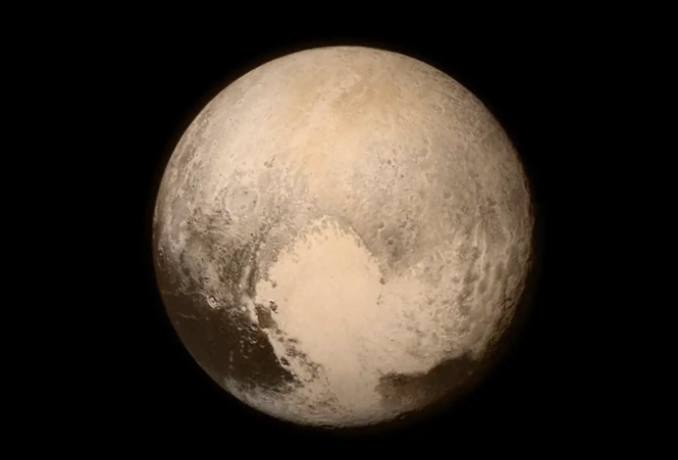
For decades, schools taught children of our solar system as one with nine planets, with Pluto recognized as the smallest and most distant of them all. This “fact” remained largely unchallenged until the early 21st century, when new discoveries in astronomy prompted scientists to reconsider what it truly means to be a planet, ultimately reshaping our view of the solar system and Pluto’s place within it.
Back in the 1800s, scientists noticed an unusual wobble in the orbits of the two outermost planets, Uranus and Neptune; a strange movement that could only be attributed to the gravitational pull of an undetected ninth planet, “Planet X.” This hypothesis sparked a decades-long search of the outer solar system among astronomers, in hopes of finding the mysterious Planet X lurking beyond the two icy giants. The search continued until February 18th of 1930, when an American astronomer identified a faint celestial body while analyzing photographic plates under a blink microscope. Eager to solve the mystery of Planet X, on March 13, 1930, scientists embraced the discovery as a new planet, naming it Pluto after the Roman god of the underworld.
Image courtesy of NASA
Over subsequent years, however, as astronomers began to examine Pluto more closely, they noticed several irregularities that made it increasingly clear that Pluto did not behave like the other planets in the solar system. Unlike the nearly circular orbits of the other eight major planets, Pluto follows a highly elliptical path around the Sun. In fact, for part of its orbit, Pluto travels closer to the sun than Neptune, an arrangement unlike any other planet. Additionally, Pluto is exceptionally small, even smaller than Earth’s moon. This was odd, particularly compared to the other four gas and ice giant counterparts that dominate the outer region of the solar system. These unusual traits raised early questions about Pluto’s classification, and whether it truly belonged in the same category as the rest of the planets or if it represented something entirely different.
Doubts surrounding Pluto’s planetary status intensified with the discovery of the Kuiper Belt in the late 20th century. This distant region beyond Neptune was found to be populated with thousands of icy objects, many of which shared striking similarities with Pluto in size, composition, and orbital behaviour. As astronomers continued to explore this region, they discovered several Pluto-like bodies, including Eris, an object appearing to be larger than Pluto that was informally dubbed the solar system’s tenth planet. Such discoveries force scientists to confront an important question: if Pluto qualifies as a planet, should all these newly discovered objects adopt that status as well? The growing number of similar celestial bodies made it increasingly difficult to justify Pluto’s unique classification and highlighted the need for a clearer, more consistent, and exclusive definition of what truly constitutes a planet.
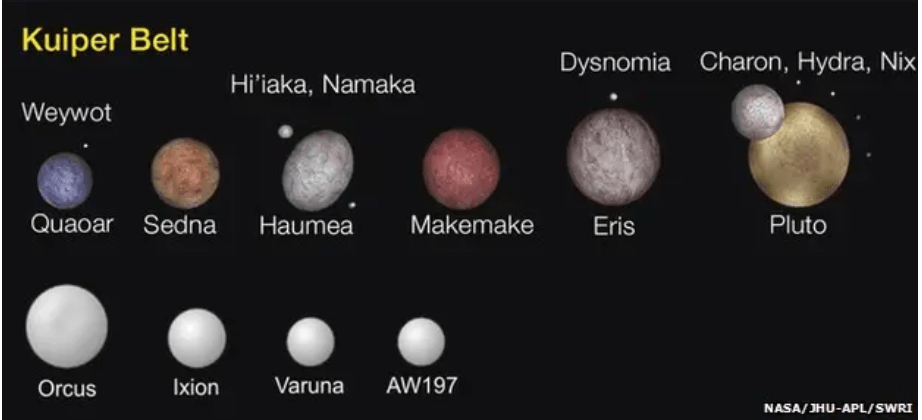
Image courtesy of NASA
In response to these new discoveries and growing inconsistencies, the International Astronomical Union was tasked to formally define what qualifies as a planet. In August of 2006, after an intense discussion period, the IAU introduced three official criteria: a planet must be a celestial body with (1) an orbit around the sun, (2) have a nearly round shape, and (3) have cleared out the neighborhood around its orbit. While Pluto satisfied the first two conditions, it failed to meet the third one, overlapping with various objects in the vast Kuiper Belt. This stripped the object of its elite status and reclassified Pluto as a “dwarf planet” alongside Eris and other icy objects beyond Neptune that lacked orbital dominance.
Pluto’s reclassification was never a demotion, but rather a reflection of scientific progress. With rapid technological advancement and new evidence, Pluto’s story serves as a reminder of our continuously evolving knowledge of science and the universe.
Works Cited
Barnett, Amanda, editor. “The Kuiper Belt.” NASA, 12 Mar. 2025, science.nasa.gov/solar-system/kuiper-belt/.
Barnett, Amanda, editor. “Pluto Facts.” NASA, 22 Apr. 2025, science.nasa.gov/dwarf-planets/pluto/facts/.
“Pluto Discovered.” History, A&E Television Networks, 3 Mar. 2010, http://www.history.com/this-day-in-history/february-18/pluto-discovered.
Rincon, Paul. “Why Is Pluto No Longer a Planet?” BBC, 13 July 2015, http://www.bbc.com/news/science-environment-33462184.
Tillman, Nola Taylor. “Clyde Tombaugh: The astronomer who discovered Pluto.” Space.com, 9 Jan. 202t, http://www.space.com/19824-clyde-tombaugh.html.
About The Author

Hi! My name is Maira and I’m a junior in high school from Karachi, Pakistan with a passion for all things STEM. Whether that be space, neuroscience, or just the simple science behind everyday experiences, I’m endlessly curious about how the world works. I aspire to one day pursue a career in STEM and want to inspire girls around me to one day seem themselves doing the same.



 Her Stem Space
Leave a comment