By: Maira Jindani
What actually happens to your body when a car stops moving? While car safety is often associated with advanced technology or clever engineering, at its core, car safety relies on a simple set of basic physics principles. Concepts such as inertia, momentum, and impulse determine how passengers move during a collision and how much force their bodies experience. During a crash, it’s physics, not chance, that ultimately decides how well a car can protect its passengers.
Two main concepts that form the foundation of modern car safety are Newton’s 1st Law of Motion and the impulse-momentum theorem. Newton’s 1st Law states that an object in motion stays in motion unless acted upon by an external, unbalanced force. This tendency to resist changes in motion is referred to as an object’s inertia. In the context of a crash, a vehicle may stop suddenly, but due to inertia, the passengers continue to move forward at the car’s original speed. Without any external forces applied to the passenger to counter motion, this greatly increases the risk of serious injury.
The impulse-momentum theorem further builds on these principles by explaining how force and time interact during a collision. Impulse describes the change in an object’s momentum, illustrating that the force experienced by an object depends on the rate at which its momentum changes. When passengers are brought to a sudden stop over a very short period of time, the resulting force is extremely large. However, by increasing the interval over which the passengers decelerate, the force exerted on the body can be significantly reduced. Modern car safety features are intentionally designed around this principle, working to counter inertia while also minimizing the magnitude of force experienced by passengers.
The most obvious example of this physics in action is the seatbelt. When a car suddenly stops, seatbelts provide the external force needed to counter the passengers inertia, preventing them from continuing forward uncontrollably. By distributing the stopping force across a large area of their torso, seatbelts reduce the risk of injury and protect passengers by bringing them to a slower, more controlled stop. Additionally, the slight stretch of seatbelts works to increase the duration of the collision, lowering the forces experienced by the passenger. Without seatbelts, this force would be concentrated over a shorter period of time and a smaller area of the body, significantly increasing the likelihood of severe injury.
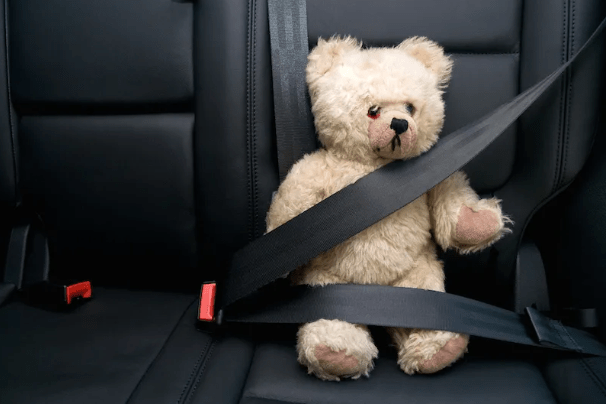
(Image courtesy of Traffic Safety Guy)
Airbags are another essential safety feature present in most modern vehicles. Rather than allowing the passenger to collide directly with the steering wheel, dashboard, or windshield, airbags deploy within milliseconds of a crash to provide cushioning against the sturdy interior surfaces of the car. In doing so, the airbag counters inertia and allows the change in the passenger’s momentum to occur over an extended interval of time. When used in conjunction with seatbelts, this results in a decreased net force, further enhancing passenger protection.
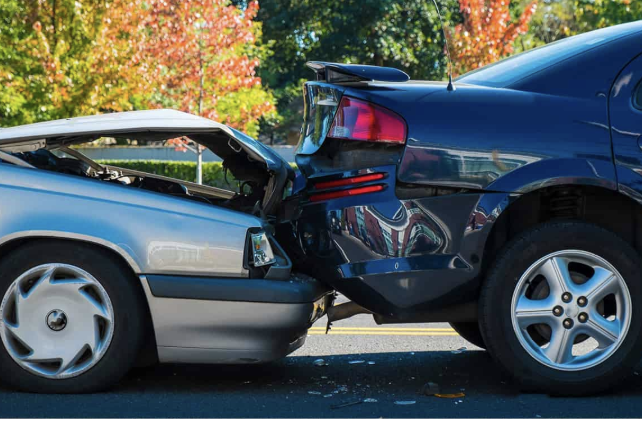
Beyond restraints like seatbelts and airbags, the structure of the vehicle itself plays a crucial role in passenger safety. Originally, engineers placed greater emphasis on maintaining the structural integrity of cars during a crash. These rigid designs, however, frequently resulted in severe injury to passengers due to extreme changes in momentum and a high impulse upon collision. That was until the late 1950s when the crumple zone was first introduced. Crumple zones are areas at the front and rear end of a vehicle intentionally engineered to deform during a crash. However, a good crumple zone doesn’t just randomly collapse; these modern car buffers are designed to crumple in a systematic manner such that they absorb the initial impact of the collision and lengthen the duration of deceleration. The slower change in momentum decreases the forces transmitted to the driver and passenger, overall reducing the likelihood of serious injury.
(Image courtesy of Physics World)
The carefully designed seatbelt, airbag, and crumple zone demonstrate how the abstract laws of physics can be practically applied to real-world situations to create life-saving technologies that transform violent collisions into controlled events, preventing injury and saving lives.
Works Cited
Grabianowski, Ed. “How Crumple Zones Work.” HowStuffWorks, auto.howstuffworks.com/car-driving-safety/safety-regulatory-devices/crumple-zone.htm.
“How Air Bags Work.” Canada.ca, Government of Canada, tc.canada.ca/en/road-transportation/publications/air-bag-deactivation/how-air-bags-work.
“Momentum Change and Impulse Connection.” the Physics Classroom, http://www.physicsclassroom.com/class/momentum/lesson-1/momentum-and-impulse-connection.
Reddy, Manoja. “How Newton’s First Law of Motion Explains Car Safety Features: Seatbelts and Airbags.” EuroSchool, 28 Sept. 2024, http://www.euroschoolindia.com/blogs/newtons-first-law-car-safety-seatbelts-airbags/.
“Using Newton’s laws to weed out bogus car-crash claims.” Physics World, 16 Aug. 2022, physicsworld.com/a/using-newtons-laws-to-weed-out-bogus-car-crash-claims/.
Wallace, David. “Seat Belts are Safety Belts – Wear Them.” Traffic Safety Guy, June 2014, trafficsafetyguy.com/seat-belts-safety-belts-wear/.
About the Author

Hi! My name is Maira and I’m a junior in high school from Karachi, Pakistan with a passion for all things STEM. Whether that be space, neuroscience, or just the simple science behind everyday experiences, I’m endlessly curious about how the world works. I aspire to one day pursue a career in STEM and want to inspire girls around me to one day seem themselves doing the same.


 Her Stem Space
Leave a comment