By: Sofiya Arnaudova
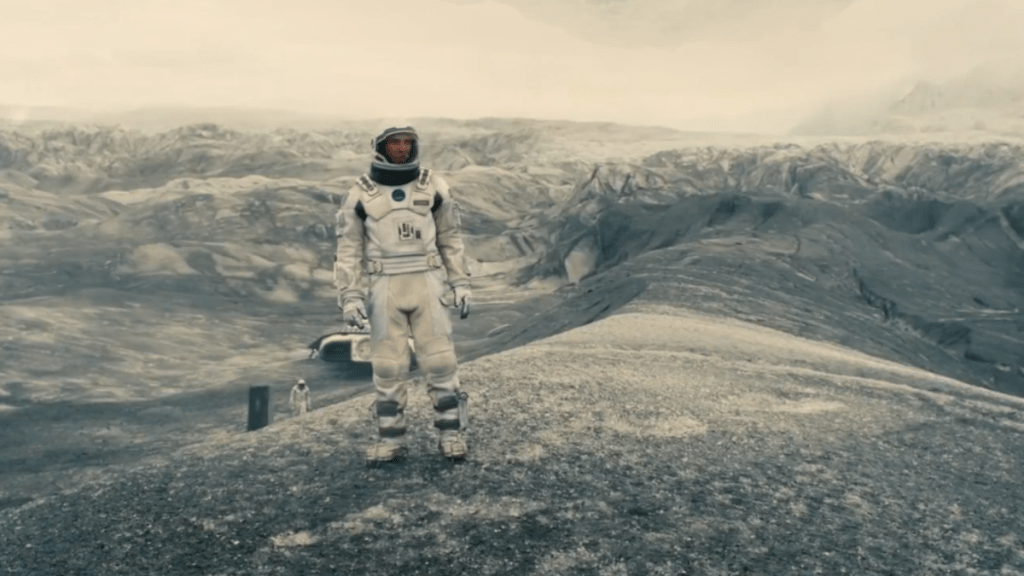
Image Courtesy of https://andphilosophy.com/2014/12/11/interstellar-and-philosophy/
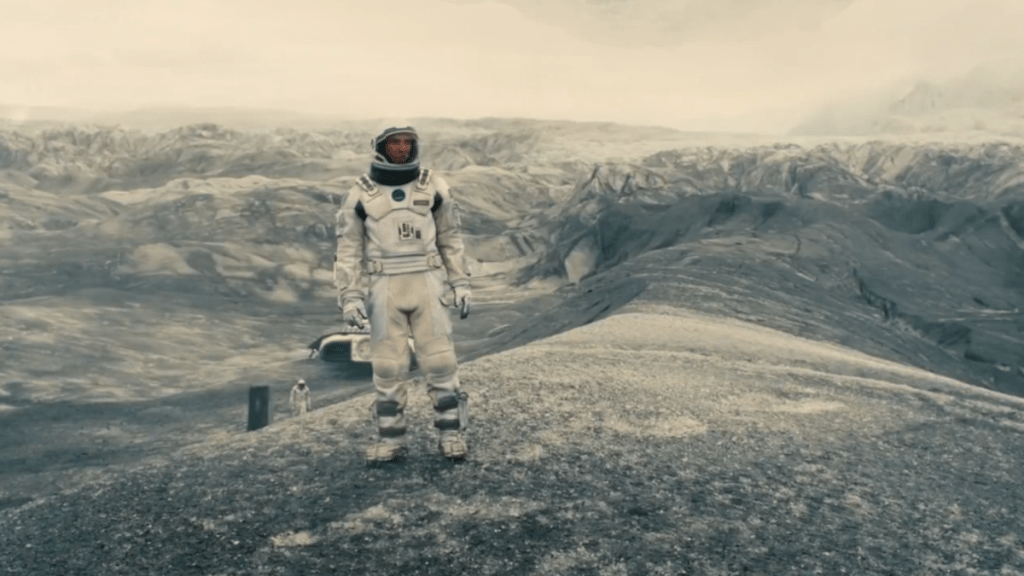
Beyond the horizon of Hollywood’s traditional sci-fi movies lies Interstellar, a cinematic odyssey that took traditional sci-fi gimmicks and applied them to the intertwined laws of theoretical physics. Directed by Christopher Nolan, the film’s $165 million production didn’t rely solely on innovation; it was built on the calculations of Nobel laureate Kip Thorne. Behind the scenes, a massive team of artists, physicists, and engineers worked to transform the equations of astrophysics into a tangible universe that could be consumed by any viewer. While the majority of best-selling films treat science as a plot device, Nolan and Thorne aimed for something more ambitious: a narrative in which the physics of the universe dictates the fate of the human heart. Yet, in a genre defined by “fiction,” where does the boundary between proven reality and speculative wonder truly lie?
To understand how Interstellar achieves this balance, it is necessary to examine its foundation in Einstein’s Theory of Relativity – specifically, the relationship between gravity and time. One of the film’s most striking examples appears on Miller’s Planet, which orbits extremely close to the supermassive black hole Gargantua. Because of this proximity, the planet exists deep within an intense gravitational well, where spacetime is so immensely curved that time slows dramatically relative to distant observers. The film quantifies this precisely: one hour on Miller’s Planet equals approximately seven years on Earth. For this to occur, Gargantua would need to be a rapidly spinning (Kerr) black hole, allowing the planet to orbit just outside the event horizon without being destroyed. While the scenario pushes the limits of being physically plausible, it is still consistent with solutions to Einstein’s field equations (Jones). By attaching this time dilation to the raw, emotional consequence of Murphy aging decades while Cooper experiences only hours, the film converts a relativistic equation into human cost.
This precision extends to the visualization of Gargantua itself. Instead of a traditional dark sphere, the black hole is depicted with an accretion disk whose light appears both above and below it. This unusual shape is not an artistic exaggeration but a direct consequence of gravitational lensing: light emitted from the far side of the disk is bent around the black hole, making it visible from multiple angles simultaneously (Tate). The rendering was generated using ray-tracing algorithms based on general relativity, tracking the exact paths of light near extreme gravity. This process led to new insights about how light behaves near rotating black holes, resulting in various scientific papers published thereafter. In this sense, the film does not merely illustrate existing knowledge but also refines it, demonstrating a loop between cinema and scientific research (Billings).
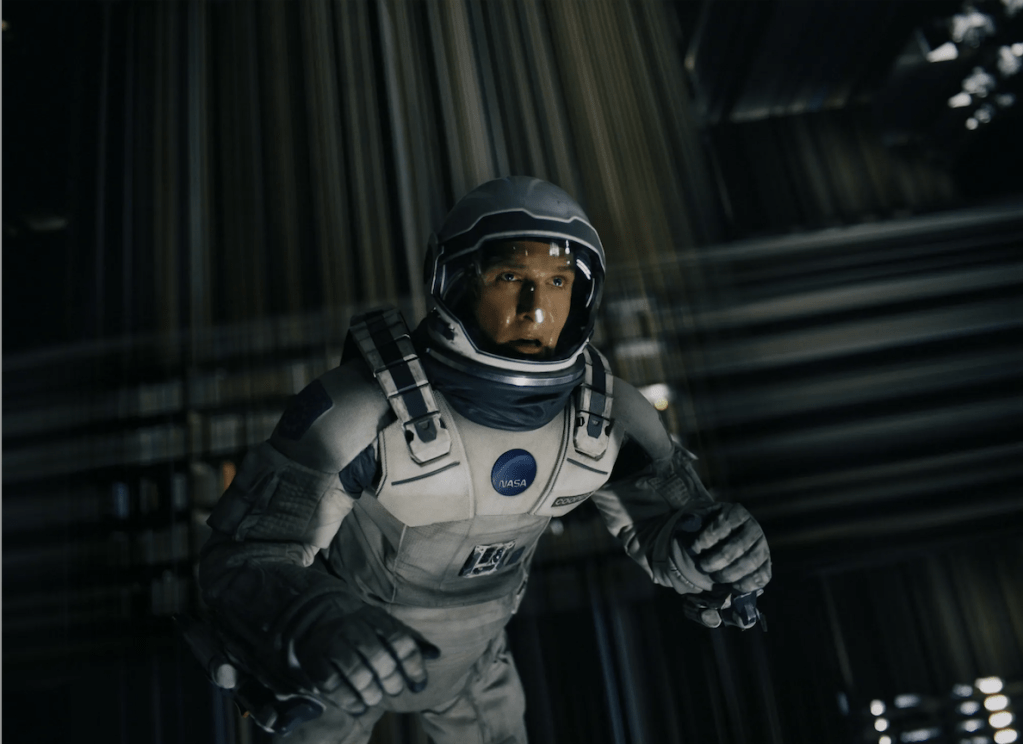
Image Courtesy of https://www.indiewire.com/features/general/inside-the-making-of-the-spectacular-tesseract-in-interstellar-189771/
However, Interstellar deliberately departs from established physics in its final act. The introduction of the tesseract presents time as a five-dimensional structure, in which every moment exists simultaneously and spatially in both past and future, despite one’s position in the relationship between space and time. While higher dimensions are predicted in frameworks like string theory, there is no evidence that humans could perceive or even interact with time in this way (Jones). The film also introduces a paradox, where Cooper transmits the very data that enables humanity’s survival, effectively becoming the cause of the future that sends him back. Here, scientific accuracy gives way to narrative necessity, allowing the film to explore the idea that gravity, and not just electromagnetic forces, can carry information across dimensions (Jones).
This tension between rigor and speculation is ultimately what gives Interstellar its depth. Rather than simplifying science, the film preserves its complexity while embedding it within emotion. Abstract principles such as relativity, event horizons, and spacetime curvature are not explained through exposition alone but are demonstrated through consequence: lost time, distorted perception, and irreversible separation. This method of storytelling does more than inform; it forces viewers to confront the implications of these ideas in a way that feels personal and genuine.
Works Cited
- “The Science behind the Movie ‘Interstellar’: Oberlin College and Conservatory.” Oberlin College & Conservatory, 17 Aug. 2019, www.oberlin.edu/news/science-behind-movie-interstellar.
- Tate, Karl. “The Science of ‘Interstellar’ Explained (Infographic).” Space, Space, 22 June 2021, http://www.space.com/27692-science-of-interstellar-infographic.html.
- Billings, Lee. “Parsing the Science of Interstellar with Physicist Kip Thorne.” Scientific American, Scientific American, 20 Feb. 2024, http://www.scientificamerican.com/blog/observations/parsing-the-science-of-interstellar-with-physicist-kip-thorne/.
- “The Science of Interstellar: Astrophysics, but Not as We Know It.” The Guardian, Guardian News and Media, 5 Nov. 2014, http://www.theguardian.com/film/filmblog/2014/nov/05/interstellar-astrophysics-does-space-science-work-out.
About the Author

Hi! My name is Sofiya, and I’m a junior in high school from Seattle, Washington. I’m passionate about physics and astrophysics, and my dream is to one day get my PhD in this field. I love dedicating my time to encouraging young women to pursue careers in STEM and opening up more avenues for them as well!

 Her Stem Space
Leave a comment