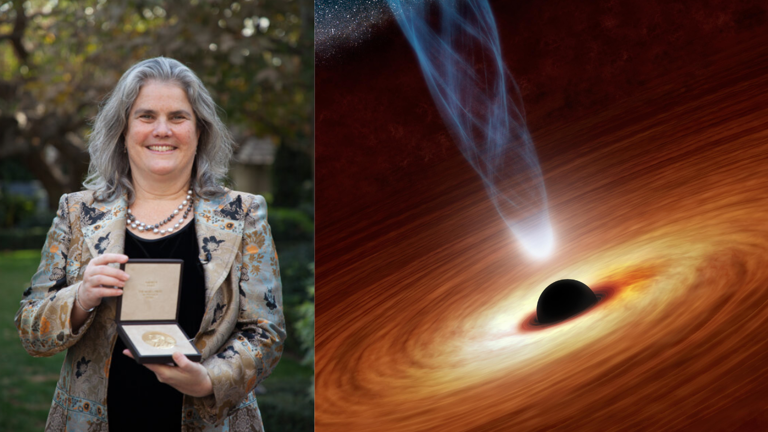
On October 6, 2020, Andrea M. Ghez became the fourth woman to receive the Nobel Prize in Physics, sharing half of the prestigious award for the discovery of a supermassive black hole at the center of the Milky Way. Her interest in astronomy and physics began at a young age when she witnessed the Apollo 11 moon landing in 1969. The historic event captured her imagination at just four years old, driving her to ask big questions about the universe. From that moment on, her path was filled with deep curiosity for solving cosmic puzzles. Although she initially planned to study mathematics at the Massachusetts Institute of Technology, she soon realized that physics better reflected her growing fascination with understanding the laws that govern the cosmos, setting her on the path toward a career in astrophysical research.
Ghez earned her bachelor’s degree in physics from MIT in 1987 before continuing her studies at the California Institute of Technology, where she completed her doctorate in 1992. During her time as a graduate student, she became increasingly interested in observational astronomy and the development of innovative technologies that could improve the resolution of astronomical images. These experiences provided her with the scientific foundation for the work that would later define her career. After joining UCLA as a professor, she assembled a research team focused on one of astronomy’s greatest mysteries: determining what existed at the very center of the Milky Way.

Studying the galactic center presented numerous challenges because of the enormous clouds of gas and dust blocking visible light from reaching Earth-based telescopes. To overcome this obstacle, she relied on infrared observations, which can penetrate these dense regions and reveal objects that would otherwise remain hidden. She also helped pioneer the use of adaptive optics, a technology that compensates for distortions caused by Earth’s atmosphere in real time. By rapidly adjusting telescope mirrors, adaptive optics produces significantly sharper images and allows astronomers to observe celestial objects with remarkable precision. These technological advancements enabled Ghez and her colleagues to collect some of the most detailed observations ever made of the Milky Way’s core.

Over many years, Ghez carefully tracked the motion of stars orbiting near the galactic center. Her team discovered that these stars were moving at extraordinary speeds around an invisible object possessing an immense gravitational pull. One particular star, known as S2, completed its orbit in only about sixteen years, providing crucial evidence about the mass and size of an unseen object. By repeatedly observing the positions and motions of stars such as S2 over many years, Ghez’s team found that their tight orbits and remarkably high speeds around an object emitting no visible light required an enormous amount of mass to be concentrated within an incredibly small region of space–approximately four million times the mass of the Sun. According to the principles of gravity and modern astrophysics, the only plausible explanation consistent with these observations was the presence of a supermassive black hole, now known as Sagittarius A*. This discovery provided some of the strongest observational evidence supporting theories for the existence of black holes and fundamentally transformed scientists’ understanding of galactic evolution and dynamics.
Beyond her groundbreaking scientific contributions, Andrea Ghez has become an important role model for future generations of scientists. As one of the few women to receive the Nobel Prize in Physics, she has challenged traditional barriers within STEM fields and encouraged young women to pursue careers in science and mathematics. Her achievements demonstrate that curiosity, perseverance, and innovation are essential qualities that can lead to extraordinary discoveries. Her journey and research remind us that asking big questions about the universe can not only deepen our knowledge, but also inspire future generations of scientists to continue exploring the mysteries of space.
Works CIted
“Andrea Ghez” Andrea Ghez, University of California, Los Angeles, https://www.astro.ucla.edu/~ghez/ Accessed 4 July 2026
“Andrea Ghez” National Women’s History Museum, https://www.womenshistory.org/education-resources/biographies/andrea-ghez
Accessed 4 July 2026
“Andrea Ghez Wins Nobel Prize in Physics” W. M. Keck Observatory, 6 Oct. 2020, https://keckobservatory.org/nobel-prize-ghez/ Accessed 4 July 2026
“Andrea Ghez – Facts – 2020 ” NobelPrize.org., Nobel Prize Outreach AB, 2026. Sat. 4 Jul 2026.<https://www.nobelprize.org/prizes/physics/2020/ghez/facts/>
Gregersen, Erik. “Andrea Ghez”. Encyclopedia Britannica, 12 Jun. 2026, https://www.britannica.com/biography/Andrea-Ghez. Accessed 4 July 2026
Chu, Jennifer “Andrea Ghez ‘87 Wins a Share if the 2020 Nobel Prize in Physics” MIT News, Massachusetts Institute of Technology, 6 Oct. 2020, https://news.mit.edu/2020/andrea-ghez-shares-2020-nobel-prize-physics-1006
About the Author

Hii! My name is Leslie, and I’m a rising senior from New York City, attending high school in Manhattan. I’m very interested in physics and astrophysics, hoping to pursue a PhD in astrophysics to become a researcher in this field while also helping to encourage and expand STEM opportunities for girls from underrepresented backgrounds.


Leave a Reply